
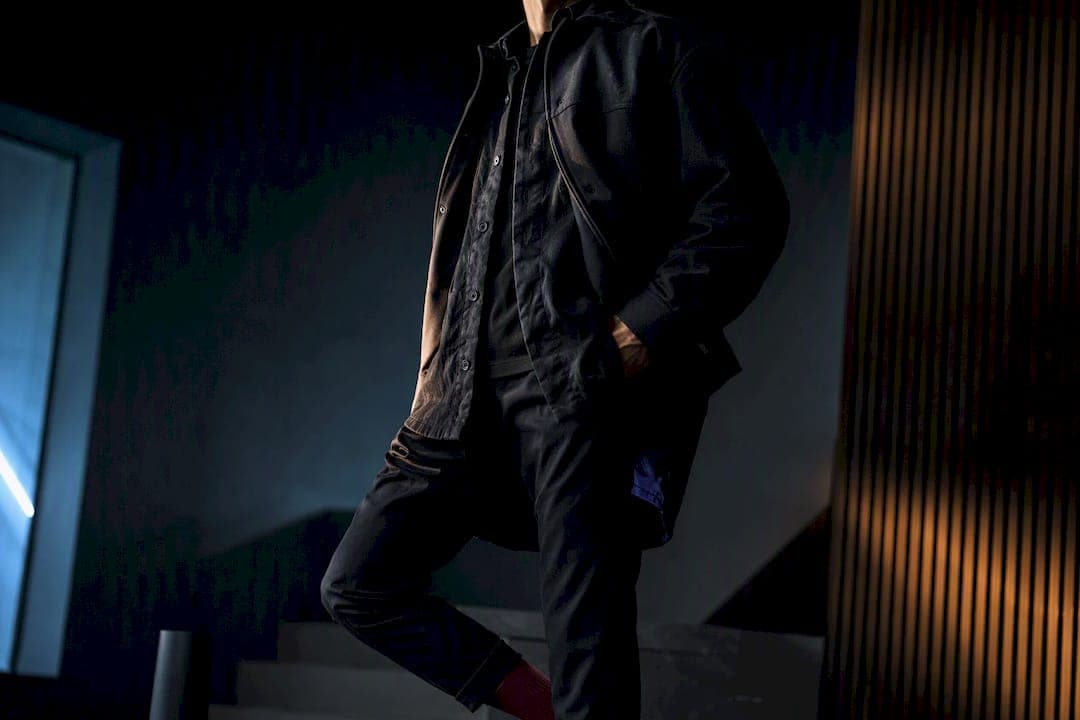
The single rule that makes an all-black outfit work: mix your textures and nail your fit, or the look goes flat fast. Run every outfit through a base, mid, and outer layer, finish with the right shoes and one or two minimal accessories, and you've got a formula you can repeat all week. That's the approach we build every look around here at Kenny Wade's World.
TL;DR:
- Ensuring each layer has a distinct texture prevents the all-black outfit from appearing flat or monotonous.
- Select a small number of versatile black pieces that each serve a specific role, focusing on fit and fabric quality for lasting style.
- Proper fit, especially in shoulder and sleeve length, is crucial because black outfits show fit issues more prominently than patterned or colorful ones.
- Use subtle tone-on-tone patterns or textures to add visual interest without breaking the monochrome effect.
- Keep accessories and accents minimal, opting for muted tones or metallics to enhance the look without overwhelming the overall outfit.
Table of Contents
- How to Build All Black Outfits for Men: The Layering Formula
- Essential Black Wardrobe Pieces Worth Owning
- All-Black Outfit Ideas for Every Occasion
- Getting Fit and Texture Right (So the Look Isn't Flat)
- Accessories, Shoes, and the Finishing Details
- Keeping Black Clothes Looking Rich, Not Faded
- Why Kenny Wade's World Builds Outfits This Way
- Incorporating Patterns Into an All-Black Look
- Dressing All Black for Different Body Types
- Using Color Accents Without Breaking the Monochrome
- The Real Reason Most Guys Get All-Black Wrong
- Shop the Look: Building Your All-Black Wardrobe
- Sources
How to Build All Black Outfits for Men: The Layering Formula
Every good all-black outfit is really three decisions stacked on top of each other. Get those three right, and the outfit takes care of itself.
Your base layer sits against your skin: a t-shirt, long-sleeve tee, or turtleneck. This piece sets the tone for texture, since it's usually the fabric people notice first when a jacket is open. Your mid layer adds shape and warmth: a hoodie, flannel, cardigan, or lightweight sweater. Your outer layer is what the world sees first: a denim jacket, bomber, blazer, or overcoat. Layering this way is the primary technique for building depth in casual all-black outfits, and it doubles as your built-in system for adjusting to weather without breaking the palette.
Here are three formulas you can copy today:
- Casual formula: plain black tee, black denim jacket, black leather sneakers. Swap the jacket for a hoodie in colder months and you've got a second outfit from the same three pieces.
- Smart-casual formula: black turtleneck, structured black blazer, black minimal leather boots. This is your dinner-and-drinks outfit, and it reads far more put-together than the effort it takes.
- Streetwear formula: black hoodie, black bomber or cargo pants, chunky black trainers. This is where black streetwear outfits live, and it's the easiest formula to personalize with hardware and proportion.
The actual process is short. Pick one texture per layer so nothing competes: matte cotton on the base, a slight sheen or brushed finish on the mid layer, and something with more structure or grain on the outer piece. Check the fit at each layer, since an all-black outfit hides color contrast but shows every loose seam. Finish with shoes last. Footwear does more heavy lifting in a monochrome outfit than almost any other single piece, and layering with distinct textures is what keeps the whole thing from reading as one flat block.
Pro Tip: Lay all three pieces flat on your bed before you put them on. If you can't tell where one layer ends and the next begins just by looking, add a texture contrast, like swapping a cotton hoodie for a waffle-knit one.
Essential Black Wardrobe Pieces Worth Owning
You don't need fifty black items. You need eight or nine that actually earn their spot in rotation, each doing a specific job.
- Black crew-neck tee. Should sit close but not tight through the chest, with the sleeve hem hitting mid-bicep. Stick to 100% cotton or a cotton-modal blend for a true, deep black that doesn't wash out gray after a few cycles.
- Black jeans. A straight or slim-straight cut is the safest bet for most builds. Raw or dry denim holds color longer than pre-washed styles, though it costs more upfront.
- Black chinos or tailored trousers. These bridge casual and smart-casual. Look for a slight taper and a break that just kisses the top of your shoe.
- Black leather jacket. This is your highest-impact single purchase. Genuine leather develops a richer, less plasticky black over time than most faux options, and the fit should hit at the waistband, not below it.
- Black blazer. Wool or a wool-blend holds shape and drapes better than cotton for this piece. Shoulders should end exactly where your shoulder ends, no overhang.
- Black overcoat. Wool or a wool-cashmere blend for real warmth. Length should land somewhere between mid-thigh and knee depending on your height.
- Black sneakers. Leather or suede uppers photograph and wear better than canvas for this specific color. Keep at least one pair reserved for cleaner outfits.
- Black dress shoes. A cap-toe oxford or a simple derby in leather covers almost every semi-formal need you'll have.
On material and price, this is where corners get cut and it shows. Cotton is forgiving and affordable but fades fastest. Merino wool costs more but resists odor, holds its black longer, and drapes better in a blazer or coat. Leather is the biggest investment of the list, but a genuine leather jacket, cared for properly, will outlast three or four cheaper synthetic versions and actually looks better as it ages. Technical fabrics, the kind used in performance joggers or shells, are worth it for outer layers you'll wear in rain or wind, but skip them for anything that touches your skin directly if you can.
All-Black Outfit Ideas for Every Occasion
Copy any of these outright. Each one uses the base, mid, outer formula, so once you own the pieces, you can mix and match beyond what's listed here.
Everyday casual
- Black crew tee, black relaxed denim, white-soled black sneakers. Swap the tee for a waffle-knit long sleeve when it's cooler.
- Black hoodie, black joggers, black slip-on sneakers. Keep the joggers tapered so the silhouette doesn't read as sloppy. This is the exact territory covered in 12 Sweatpants Outfits That Look Styled, Not Sloppy, which is worth a look if loungewear is your default.
- Black t-shirt, black chino shorts, black canvas low-tops for warm weather. Canvas is your one exception to the leather-sneaker rule here, since it breathes better in heat.
Date night 4. Black fitted button-up (untucked), black slim jeans, black leather Chelsea boots. Swap a plain leather belt for suede to add a texture break at the waist. 5. Black turtleneck, black tailored trousers, black leather loafers. This is minimal effort for maximum payoff, and the turtleneck alone does most of the visual work.
Smart-casual or office 6. Black oxford shirt, black wool blazer, black dress trousers, black leather derbies. Get the blazer tailored at the shoulder even if nothing else gets altered. It's the one adjustment that changes how the whole outfit reads. 7. Black merino sweater, black chinos, black suede desert boots. Suede against the wool sweater gives you two distinct textures without adding a single color.
Streetwear 8. Black graphic tee, black cargo pants, black bomber jacket, chunky black trainers. Let the cargo pockets and bomber's ribbed cuffs act as your texture and detail points, since functional utility details translate well into monochrome when you don't cover them up. 9. Black hoodie under a black varsity jacket, black straight-leg denim, black high-top sneakers. This is peak monochrome streetwear outfits territory, and it's forgiving if you're still building your black wardrobe from scratch.
Loungewear and semi-formal Round these out with a black fleece and black sweatpants for loungewear, or a black three-piece suit with a matte black tie for semi-formal. In both cases, the same rule applies: at least one matte piece and one piece with visible texture, whether that's a ribbed cuff or a subtle herringbone weave in the suit fabric.
For seasonal adjustments, swap cotton and canvas for wool and leather as it cools down, and drop the outer layer entirely once it's warm enough that a tee and chinos can stand on their own.
Getting Fit and Texture Right (So the Look Isn't Flat)
Monochrome outfits amplify every fit problem you have. A pair of jeans that's a half-inch too long or a jacket with shoulders that droop past your actual shoulder line will stand out far more in black than it ever would in a patterned or colored outfit, because there's nothing else competing for the eye's attention.
Run these four checks before you leave the house:
- Shoulder seam: it should sit right at the edge of your shoulder bone, not past it. A jacket with shoulders that extend beyond this point will always look borrowed.
- Sleeve length: should end right where your wrist bone is, exposing maybe a half-inch of shirt cuff underneath.
- Crotch and drop (for pants): the crotch seam should sit close to your body, not several inches below it. Excess drop is one of the most common fit mistakes in casual all-black outfits.
- Trouser break: a slight break at the shoe is the safest bet for most builds; a full break reads sloppy, no break at all reads like you outgrew the pants.
On texture, the pairing rules are simple once you know them. Matte cotton next to glossy leather creates contrast without adding color, which is exactly why a leather jacket over a cotton tee is such a reliable combination. A chunky knit next to structured wool trousers gives you a similar effect from the other direction. Save any actual sheen, like a satin bomber or patent leather shoe, as a small accent rather than a dominant piece, since too much shine in one outfit starts to look costume-like rather than sharp.
For silhouette, balance is the whole game. If your top half has volume (an oversized hoodie, a boxy jacket), keep the bottom slim. If you're shorter, a long overcoat can visually cut your height, so a cropped jacket or mid-thigh coat length usually works better. If you're taller or broader, that same long overcoat becomes an asset, adding a clean vertical line instead of overwhelming your frame. This is one reason current silhouette trends lean toward slightly tapered cuts. They're more forgiving across different body types than the boxier shapes that dominated a few years back.
Pro Tip: Stand in front of a mirror and squint. If the whole outfit blurs into one shapeless mass, you need either a texture swap or a silhouette adjustment, since color alone won't fix it.
Accessories, Shoes, and the Finishing Details
Footwear carries more weight in an all-black outfit than in almost any other color combination, because it's often the only piece with a genuinely different material.
- Sneakers work for everyday and streetwear builds; leather or suede uppers look more intentional than mesh or canvas.
- Boots, especially Chelsea or combat styles, bridge casual and smart-casual and hold up well through fall and winter.
- Loafers are your move for date night or dressed-down office days, since they read as effortless without tipping into sloppy.
- Dress shoes, an oxford or simple derby, are non-negotiable for semi-formal all-black outfits.
Keep jewelry minimal. Stylists consistently point to restrained jewelry and letting shoes carry the finishing statement as the difference between a sharp monochrome outfit and one that looks like it's trying too hard. A single black leather strap watch or a thin matte-black chain does more than three stacked accessories ever will. Match your metal tones too: matte gunmetal hardware pairs better with a black leather jacket than polished silver, which can look slightly out of place against deep black.
If you want a single accent color, keep it to one spot. A white tee peeking out from under a black jacket, a deep burgundy sock showing above a boot, or a muted olive scarf all work because they're small and singular. Two accent colors in one outfit usually competes with the monochrome effect instead of complementing it.
Keeping Black Clothes Looking Rich, Not Faded
Black fades faster than almost any other color if you treat it carelessly, and once it fades to gray, no amount of styling saves the outfit.
- Wash in cold water and turn everything inside out first; this alone cuts down significantly on surface friction and fading.
- Use a gentle detergent formulated for dark fabrics, since regular detergent contains brighteners that actively lighten black over time.
- Skip the dryer's heat when you can. Air-dry flat for tees and knitwear, and hang structured pieces like blazers and coats.
- Fold knits instead of hanging them to avoid shoulder stretching, and store coats with breathable garment covers rather than plastic.
- Handle small repairs immediately: a lint roller and a fabric shaver keep sweaters and hoodies looking new, and a leather conditioner treats scuffs on jackets and boots before they set in.
Following cold-wash, inside-out routines with darks-specific detergent genuinely slows fading and keeps the texture of the fabric intact for longer, which matters more in black than any other color since fading here reads as damage, not patina.
Why Kenny Wade's World Builds Outfits This Way
Kenny built this brand around a simple idea: clothes should work as hard as the music does. That means every recommendation here comes from actually thinking through how pieces move, layer, and wear over time, not from theory. Kenny Wade's World exists at the intersection of fashion and music culture, and the styling advice reflects that. Practical, repeatable, and built for people who want to look sharp without overthinking it every morning.
If you want to see this formula in action beyond the examples above, Men's Streetwear Outfits: 5 Looks You Can Copy Now breaks down five complete builds you can lift directly. For a broader view of where monochrome and silhouette are headed, Men's Fashion Trends 2026 covers the shifts worth paying attention to this year.
The editorial promise is simple: every outfit idea on this site is something you can actually assemble or buy, not an abstract mood board. That's the whole point of a formula-based approach over a "just wear black" one.
Incorporating Patterns Into an All-Black Look
An all-black outfit doesn't have to mean zero pattern. It means the pattern has to work in tone-on-tone rather than contrast.
Subtle textures like a herringbone weave in a blazer, a jacquard knit in a sweater, or a tonal houndstooth in trousers all read as pattern up close but blend into solid black from a few feet away. That's the sweet spot: visual interest for anyone paying attention, without breaking the monochrome effect for anyone glancing across a room.
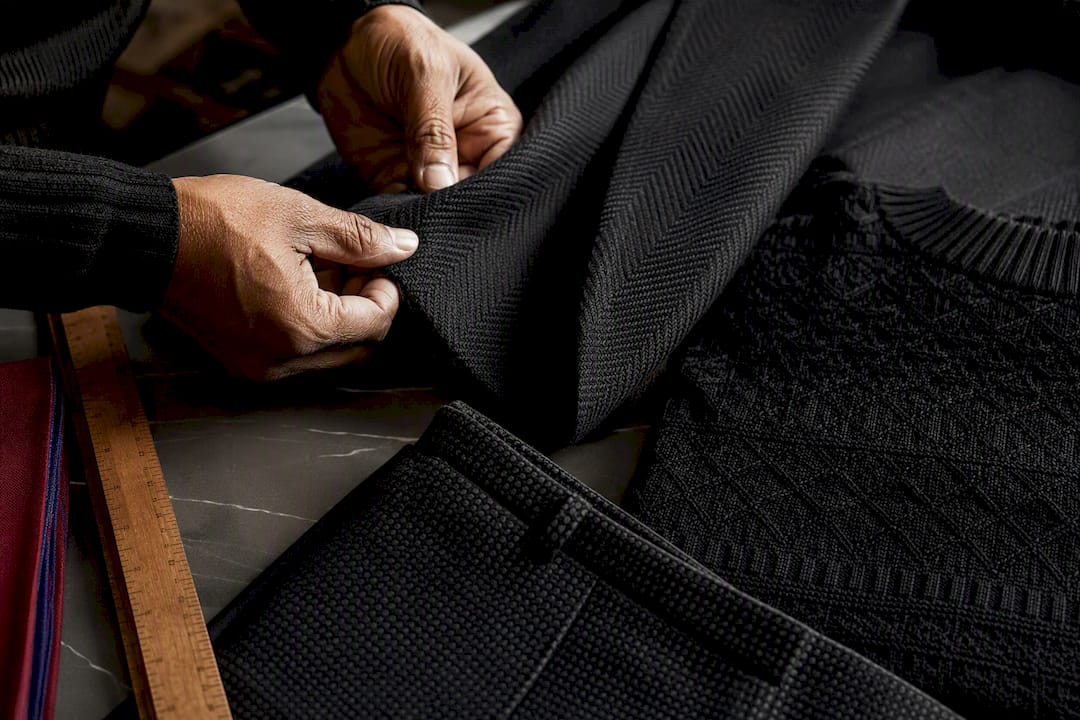
Where this gets tricky is scale. A large, high-contrast pattern, even in shades of black and charcoal, can start to look busy or dated fast. Smaller, tighter patterns age better and pair more easily across your other pieces. A pinstripe in a black suit is a classic example: it adds formality and visual depth without introducing a second color.
Streetwear opens this up further. A tonal camo print on a bomber jacket, or a subtle logo repeat on a hoodie, functions almost like the texture-mixing rule from earlier. It's a detail your eye catches on second look rather than first, which is exactly what keeps a pattern from fighting the rest of the outfit. Treat pattern the same way you'd treat an accent color: pick one place for it, and let everything else stay quiet.
Dressing All Black for Different Body Types
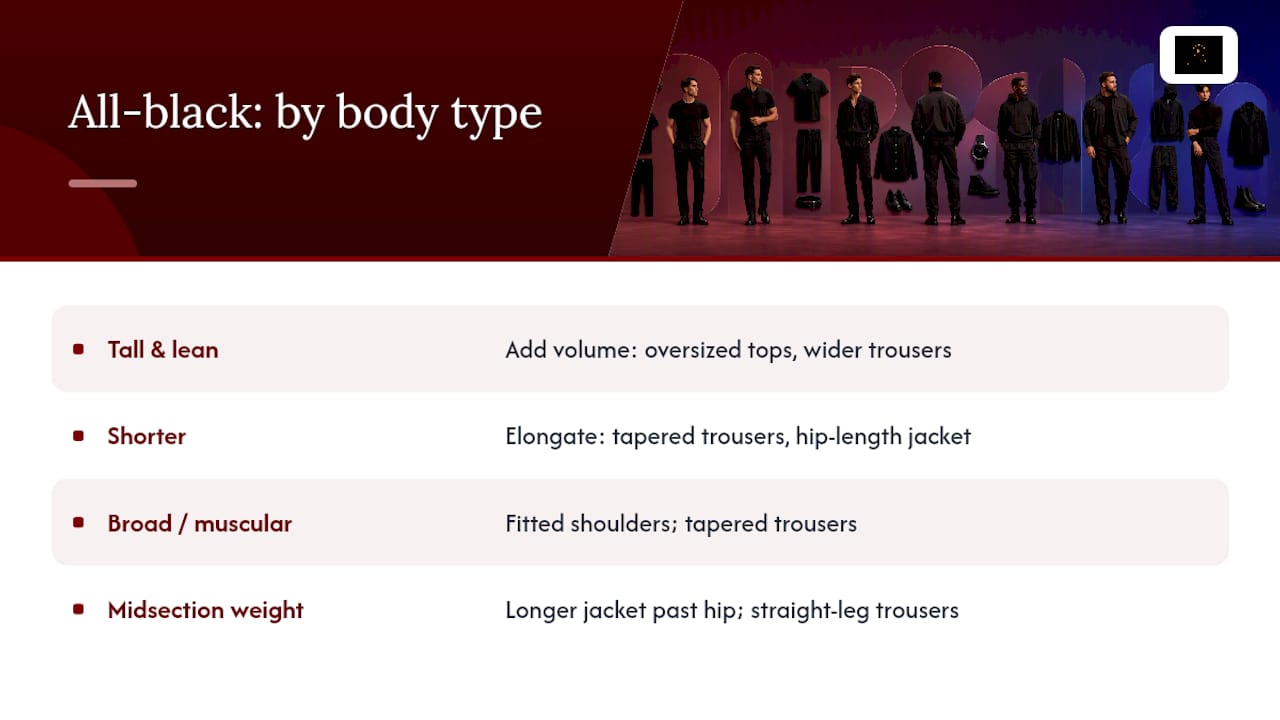
The rules that work for one build won't automatically work for another, and this is where the silhouette advice from earlier gets specific.
If you're tall and lean, volume is your friend. An oversized hoodie, a relaxed denim jacket, or wider-leg trousers add mass without looking baggy, since your frame has the length to support it. Skinny-fit everything on a tall, lean build can start to look like you're wearing kids' clothes stretched too far.
If you're shorter, the goal shifts to elongating your line. Slimmer trousers with a slight taper, a jacket that ends at the hip rather than mid-thigh, and shoes with a slightly higher vamp all help. Avoid oversized outer layers, since they tend to swallow a smaller frame rather than complement it.
If you're broad-shouldered or muscular, structured tailoring matters more than it does for other builds. A blazer or jacket that's actually fitted through the shoulder and chest, rather than boxy, will look sharper than an oversized version of the same piece. Slightly tapered trousers balance a broader top half.
If you're carrying more weight in the midsection, a slightly longer jacket or overcoat that breaks past the hip creates a cleaner vertical line than a cropped jacket will. Straight-leg trousers, rather than skinny or super wide, tend to sit better across the board.
None of this is about hiding your build. It's about choosing proportions that work with it.
Using Color Accents Without Breaking the Monochrome
Full commitment to black doesn't mean zero color, ever. It means every accent gets chosen on purpose.
Metallics are the easiest entry point. A gunmetal watch case, matte black or brushed silver hardware on a jacket's zippers, or a dark pewter belt buckle all read as part of the black palette rather than a break from it, since metallic tones sit closer to black and gray than they do to true color. Avoid anything with high shine or gold tones here. Gold specifically tends to clash with black's coolness rather than complement it.
Muted, desaturated colors work the same way. A deep burgundy sock, an olive-green scarf, or a charcoal-blue beanie all sit close enough to black in tone that they register as texture shifts rather than color statements. This is different from bright, saturated colors like red or royal blue, which will always announce themselves and pull focus away from the monochrome effect you're going for.
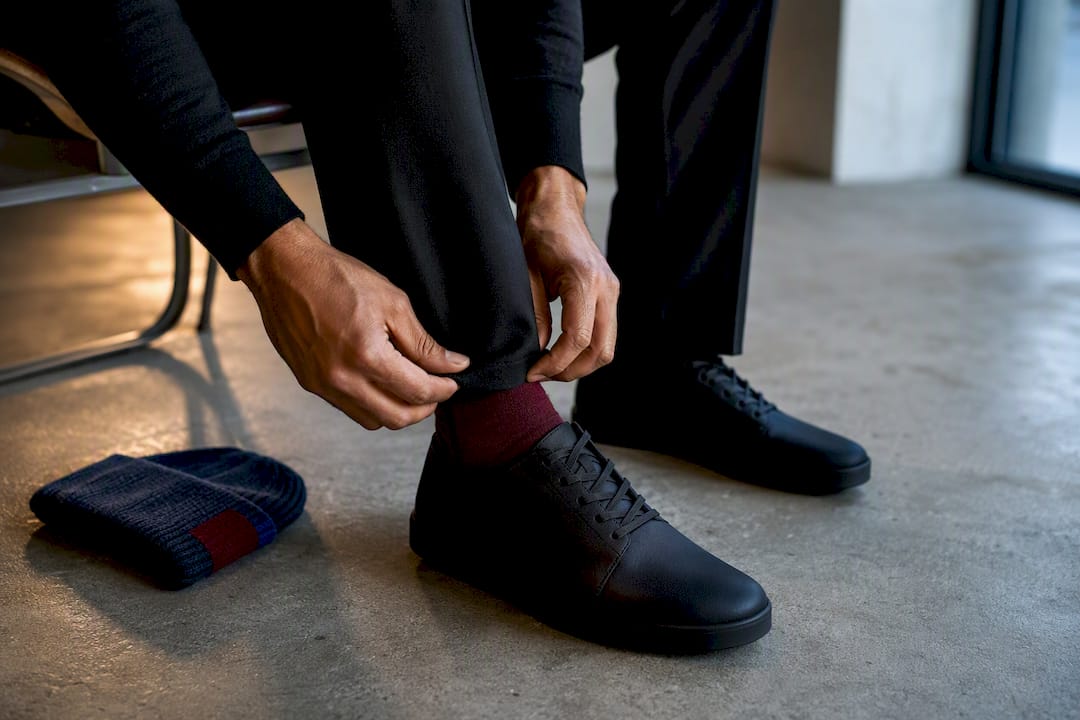
The rule that ties both approaches together: pick one accent point per outfit, keep it small, and keep it muted or metallic rather than bright. A hat, a sock, a watch, or a belt buckle is plenty. Two or more accents, even subtle ones, starts to dilute the reason an all-black outfit works in the first place.
The Real Reason Most Guys Get All-Black Wrong
Most advice on this topic treats all-black like a costume choice: wear it and you're automatically edgy or mysterious. That framing misses the actual mechanics of why it works. All-black succeeds because it removes color as a variable and forces every other detail, fit, texture, proportion, to carry the outfit. Skip that step and you get a flat, one-note look that reads as trying too hard rather than dressed well.
The conventional wisdom oversells fabric choice and undersells fit. You can own the most expensive black leather jacket available, and it will still look worse than a $40 tee if the shoulders don't sit right. Prioritize fit first, texture second, and treat color accents as the last five percent of the outfit, not the foundation.
What surprises most guys once they actually try the base, mid, outer formula is how little it costs to look consistently sharp. You don't need fifty pieces. You need eight or nine that fit correctly and mix texture well, worn in different combinations. That's the whole system.
— Kenny
Shop the Look: Building Your All-Black Wardrobe
Every formula in this guide maps directly to a selection of black tees, joggers or straight-leg pants that hold their shape wash after wash, and outer pieces designed to layer without adding bulk. The pieces aren't styled in isolation, they're built to work inside the exact base, mid, outer system covered above.
If you want ready-made pieces rather than piecing your wardrobe together from scattered sources, start here and browse what's currently available. Kenny Wade's World blends that clothing with the music side of the brand, so you're not just buying a t-shirt, you're buying into the same identity behind the sound. For a next step beyond apparel, check out how Kenny approaches building an audience and sales around music, since the same practical, no-fluff mindset behind these outfit formulas runs through that guide too.
Sources
- All Black Outfit for Men: 15 Stylish Ways to Master the Modern Monochrome Look - The Male Edit
- 24 All-Black Outfits for Men: Casual, Classy & Streetwear Styles – The Man Standard