
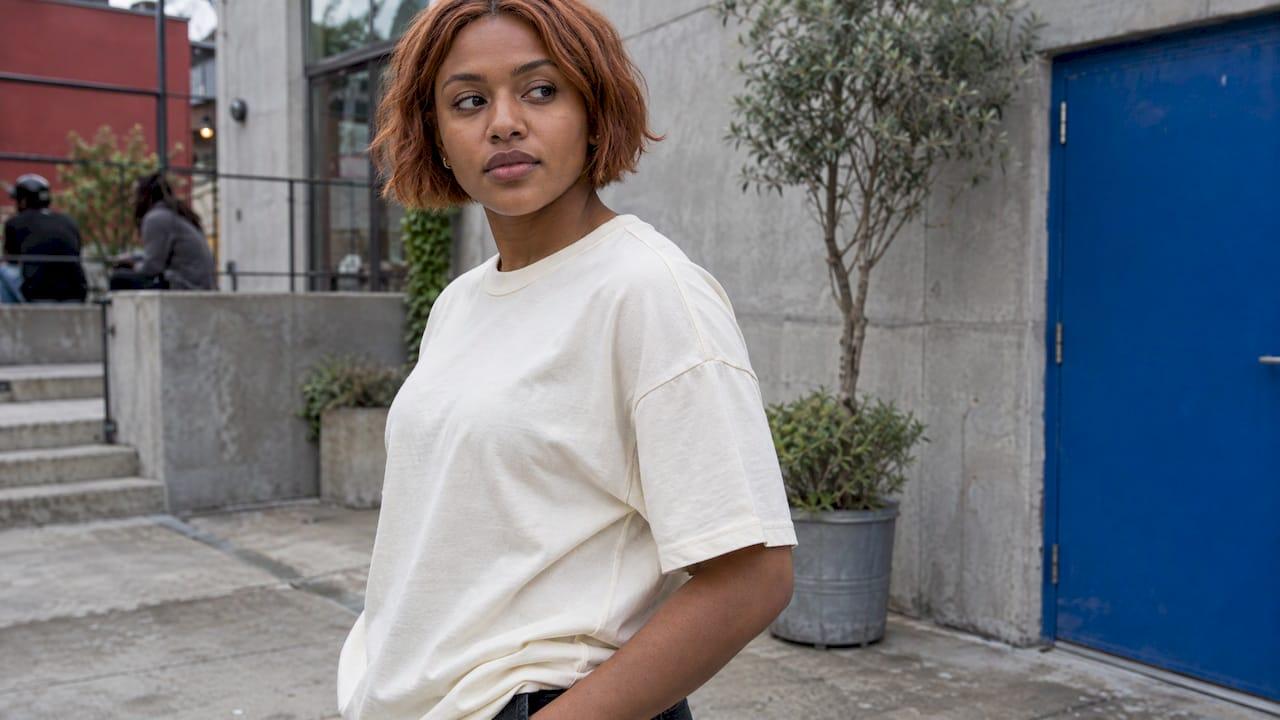
A drop shoulder is a way of building a shirt, sweatshirt or sweater so the sleeve joins the body below your natural shoulder point, out on the upper arm. Dictionary.com defines it as a garment construction in which the sleeve is joined to the body below the wearer's shoulder. The result is a softer, looser shoulder line and the slouchy look you see on hoodies, boxy tees and vintage rugby shirts.
This guide explains what the term means, how to spot it on a product page or in a mirror, how it compares with raglan and set-in sleeves, and whether it means "oversized" (it doesn't, quite).
TL;DR
- A drop shoulder puts the sleeve seam below the edge of your shoulder, on the upper arm, instead of at the shoulder joint.
- It describes seam placement, not size. A garment can be oversized without a drop shoulder, and a fairly neat one can have a slight drop.
- Raglan sleeves run diagonally up to the neckline. Set-in sleeves sit in a shaped armhole at the shoulder. A drop shoulder moves that armhole seam lower.
- The style suits casual pieces such as tees, hoodies and sweatshirts. It looks relaxed and broadens the upper body visually.
- Brands use "drop shoulder," "boxy" and "oversized" loosely, so check the measurements, not just the name.
Table of Contents
- What drop shoulder means in clothing
- How to spot a drop shoulder in the mirror
- Does drop shoulder mean oversized?
- Drop shoulder vs set-in sleeve
- Drop shoulder vs raglan
- Who looks good in a drop shoulder
- How to shop for a drop shoulder (and read the label)
- Styling a drop shoulder piece
- Our perspective
- Shop casual wear from Kenny Wade's World
- FAQ
- Sources
What drop shoulder means in clothing
Every top has a seam where the sleeve meets the body. On a classic fitted shirt, that seam sits right at the point where your shoulder ends and your arm begins. On a drop shoulder garment, the seam has slid down. The body panel extends past the shoulder bone, and the sleeve starts partway down the arm.
You will also see it called a "dropped shoulder." The two terms mean the same thing. Apparel Search's glossary describes the seam as dropping down onto the upper arm, below the natural shoulder point.
Three things follow from that one change in construction:
- The shoulder line softens. There is no crisp edge at the top of your arm. The fabric slopes from neck to sleeve.
- The armhole gets bigger. Because the seam moved down and out, the armhole is cut wider and deeper, and the sleeve hangs looser through the upper arm.
- The sleeve gets shorter in the cut. The body takes over part of what would normally be sleeve, so the sleeve piece itself is shorter and the join lands somewhere on the bicep.
How far does the seam drop?
There is no single standard. A slight drop reads as a relaxed basic. A deep drop adds obvious width and a squared-off silhouette. When a brand publishes a measurement for the drop or shows the garment flat with the seam position marked, that number tells you more than any style word.

Where the term comes from
The phrase has an older life in dress history. The Oxford English Dictionary entry for "drop shoulder" records an earlier sense for a dress or blouse style that leaves the shoulders bare. In everyday fashion shopping today, the meaning is the seam-below-the-shoulder construction described above.
How to spot a drop shoulder in the mirror
You don't need a spec sheet to recognize one. Put the top on, stand naturally with your arms at your sides, and look at where the sleeve seam lands.
- Find your shoulder point. This is the bony edge at the top of your arm, where the shoulder ends.
- Find the seam. On a standard top, it sits on or very near that point. On a drop shoulder, it sits visibly lower, often on the upper arm.
- Check the angle. On a drop shoulder, the line between the sleeve and body is close to horizontal, which draws the eye across the body rather than down it. Knitty notes this is one reason the style can make a wearer look broader than they are.
- Look at the transition. On a well-made piece, the seam rests stably on the arm and the shift from body to sleeve looks smooth rather than collapsed. MODAKNITS uses this as a test for a true drop shoulder.
If the seam sits at your shoulder but the whole shirt is simply big, you are looking at an oversized cut with a regular shoulder, not a drop shoulder.
Does drop shoulder mean oversized?
Not exactly, and this is the question people most often get wrong. The two words describe different things.
- Drop shoulder describes construction: where the seam sits.
- Oversized describes volume: how much bigger the garment is than standard sizing for your size.
The Apparel Search glossary puts it plainly: a garment can be oversized with the seam on the shoulder, and a neat garment can drop its seam slightly. FashionHDL makes the same point from the sweater side, saying body width, armhole depth and sleeve volume all affect how a piece sits, so construction alone doesn't set the fit.
In practice the two often travel together. Dropping the seam is the easiest way to give a body a relaxed, roomy hang, so many oversized hoodies and tees use it. But you can find slim-fit shirts with a drop shoulder for a retro look, where the torso stays close to the body.
There is a catch if you want the drop-shoulder look from a regular garment. Buying a tee several sizes up won't recreate it. The sleeve seam will still sit near your shoulder and the whole shirt will just look too long and baggy, because the shoulder line was never moved.
To sort out where relaxed ends and oversized begins, our guide to spotting relaxed versus oversized fits walks through the measurements. If you are weighing boxy cuts specifically, see these five fit checks for boxy versus regular.
Drop shoulder vs set-in sleeve
A set-in sleeve is the traditional construction. The sleeve is sewn into a shaped armhole, and the seam rings the shoulder joint. The sleeve cap, the curved top of the sleeve piece, has some extra fabric eased in, which gives a clean, structured shoulder. In the Folds describes set-in sleeves as tailored and polished, while a dropped shoulder reads as slouchy and laid-back, with a boxier fit.
The key point: a drop shoulder is a variation on the set-in idea, not a separate species. The seam is simply repositioned lower on the arm. That has a few knock-on effects:
- The armhole curve is flatter, and the sleeve cap is lower and wider. As MPattern's pattern-making notes explain, a low armhole needs a low, wide cap with little or no gathering.
- Most of the ease is removed, so the sleeve can often be sewn in flat. That is a big reason the style is so common on casual knits and fleece.
- You get a relaxed silhouette, but not the crisp shoulder edge of a tailored shirt. Apparel Search also notes that a very deep drop can limit how high you can comfortably lift your arm.
Seamwork describes a drop shoulder as a mash-up between a set-in sleeve and a cut-on sleeve: part of the sleeve is cut with the garment and an extension is set in, so the seam falls below the shoulder point.
Drop shoulder vs raglan
The raglan is a different construction altogether. The sleeve reaches all the way to the neckline, and the seams run diagonally from the underarm up to the neck at the front and back. The shoulder is part of the sleeve. Simply Sewing magazine notes that this gives a much greater range of movement, which is why you see raglans on the classic baseball tee.
A drop shoulder keeps the seam running around the arm, just lower, and gives the body panel extra width across the top. The raglan's seams point up toward your neck. The drop shoulder's seam runs across your upper arm.
| Feature | Set-in sleeve | Raglan sleeve | Drop shoulder |
|---|---|---|---|
| Where the seam sits | At the shoulder joint | Diagonal, from underarm to neckline | Below the shoulder, on the upper arm |
| Shoulder line | Defined and structured | Soft and rounded | Wide, square and relaxed |
| Typical look | Tailored, polished | Sporty, athletic | Slouchy, streetwear |
| Arm movement | Most restricted overhead | Best overhead movement | Good, but unstructured |
| Best for | Shirts, fitted tees | Baseball tees, sportswear | Hoodies, sweatshirts, boxy tees |
The movement comparisons follow Voyager Textile's breakdown of the three sleeve types. They describe general tendencies, since body width, armhole depth and fabric all change how a given piece feels.
One more detail worth knowing: raglans have a reputation for being fiddly, but Simply Sewing points out they can actually be easier to draft and sew than an inset sleeve, because the curves on the sleeve and torso seam match up.
Who looks good in a drop shoulder
The drop shoulder is a casual silhouette. It works best on the pieces built around comfort: tees, hoodies, sweatshirts and knit pullovers. It is less at home in tailored, close-fitting clothing, where it can look sloppy. Knitty says drop shoulders are generally unsuitable for tight pullovers.
Some practical guidance for choosing:
- If you want to look broader through the shoulders, the style helps. The horizontal seam and loose body add visual width.
- If you'd rather play down a broad upper body, a set-in or raglan sleeve gives a cleaner line, as the Sewguide style notes suggest.
- If you have a slim frame or a large bust on a small frame, fabric matters. Patty Lyons recommends a drapey fabric to avoid the oversized box look, and notes that a modern version can add waist shaping in the back.
- If you move a lot, pick a modest drop. A very deep one can restrict how high your arm lifts.
One trade-off to know about: with arms down at your sides, fabric can bunch up at the underarm on a deep drop. A moderate drop and a fabric with some drape keep that in check.
How to shop for a drop shoulder (and read the label)
The terms "drop shoulder," "boxy" and "oversized" are used loosely by brands, and no standards body defines them. DAX Show advises shoppers to read the spec bullets and measurement chart rather than trusting the product name. Here is a quick checklist.
- Look for the shoulder measurement. Compare the garment's shoulder width with your own. If the garment's number is noticeably wider than yours, the seam will land on your arm.
- Check chest width and length together. A drop shoulder looks balanced when body width and length are in proportion. A wide body that is too short, or too long, reads as shapeless.
- Note the fabric weight. Heavier fabrics help a wide body hold its shape instead of collapsing, which keeps the transition at the seam smooth.
- Look at model photos with arms down. Notice where the seam hits the arm and how the fabric falls under it.
- Size with intent. If the piece is designed with a drop shoulder, your usual size is usually the right starting point. Sizing up on top of a drop adds a lot of volume.
For related questions on hoodies, our hoodie vs sweatshirt breakdown covers neckline, pockets and fabric, and the zip hoodie vs pullover guide helps with choosing the cut.
Styling a drop shoulder piece
Because the top is roomy through the shoulders and body, balance it elsewhere.
- Pair it with a slimmer or straight bottom. Straight jeans, tapered joggers or a fitted skirt keep the whole outfit from going shapeless. See our sweatpants outfit ideas for ways to keep relaxed looks styled.
- Show a bit of structure. A cap, clean sneakers or a sleek jacket on top give the outfit an anchor. Our hoodie outfit ideas show several ways to do this.
- Let a graphic carry the look. A boxy tee with a drop shoulder is a natural canvas for band and vintage graphics, and our graphic tee outfit formulas cover how to wear them.
- Mind the sleeve length. With the seam lower, sleeves can feel short. Push them up or cuff them if they hit awkwardly.
Our perspective
We think of the drop shoulder as the easiest way to make a piece feel like it belongs to you rather than to a dress code. It takes the stiffness out of the shoulder and leaves room for movement, which is what casual wear should do.
At Kenny Wade's World, we build around a blend of comfort and style, and we want every piece to be versatile enough for different occasions. Shoulder shape is part of that conversation: a relaxed line can go from a day out to a late night with music playing, with a small change of shoes or layers.
Our advice is simple. Learn where the seam sits, look at how the garment is described, and pick the cut that matches how you actually live in your clothes. Style should feel effortless, and the right fit is where that starts.
Kenny Wade
Shop casual wear from Kenny Wade's World
If you are building a wardrobe around relaxed, versatile pieces, take a look at our casual wear. We design clothing to balance comfort and style, and to be easy to wear across different occasions, with Kenny Wade's music and creative identity running through the brand.
Browse the full range at Kenny Wade Clothing, and check each product page for sizing details before you order.
FAQ
What is a drop shoulder?
It is a garment construction where the sleeve is joined to the body below your natural shoulder, usually on the upper arm. The shoulder line looks softer and the armhole is wider and deeper. It is common on tees, hoodies, sweatshirts and sweaters.
Does drop shoulder mean oversized?
No. Drop shoulder describes where the seam sits, while oversized describes how big the whole garment is. Many oversized pieces use a drop shoulder, but a slim-fit shirt can have one too. Check the measurements to see how the piece will actually fit.
What is the difference between a drop shoulder and a raglan sleeve?
A raglan sleeve runs diagonally from the underarm up to the neckline, so the shoulder is part of the sleeve. A drop shoulder keeps a seam around the arm but moves it down past the shoulder point, with a wider body panel across the top. Raglans suit sporty looks, while drop shoulders suit slouchy streetwear.
Is a drop shoulder a set-in sleeve?
By construction, yes, with a twist. The sleeve is still sewn into an armhole, but the seam is moved lower on the arm, the cap is flatter and most of the ease is removed. A standard set-in sleeve keeps the seam at the shoulder for a more tailored, structured look.
Who should wear a drop shoulder?
Anyone who wants a relaxed, casual silhouette. It adds visual width across the shoulders, so it flatters people who want that effect. If you prefer a streamlined upper body, a set-in or raglan sleeve gives a cleaner line, and a drapey fabric helps a drop shoulder hang well on a slim frame.
Sources
- Dictionary.com: drop shoulder definition
- Apparel Search: drop shoulder glossary entry
- Knitty: shoulder shapes and fit
- MODAKNITS: fit and proportion rules for drop shoulder T-shirts
- FashionHDL: raglan vs drop shoulder sweater
- Sewguide: drop-shoulder style in fashion
- In the Folds: dropped shoulder to set-in sleeve
- MPattern: dropped shoulder glossary
- Seamwork: how to sew a set-in sleeve
- Simply Sewing: how to sew a raglan sleeve
- Voyager Textile: set-in vs raglan vs dropped shoulder
- Patty Lyons: sweater fit guide
- DAX Show: drop shoulder T-shirts