
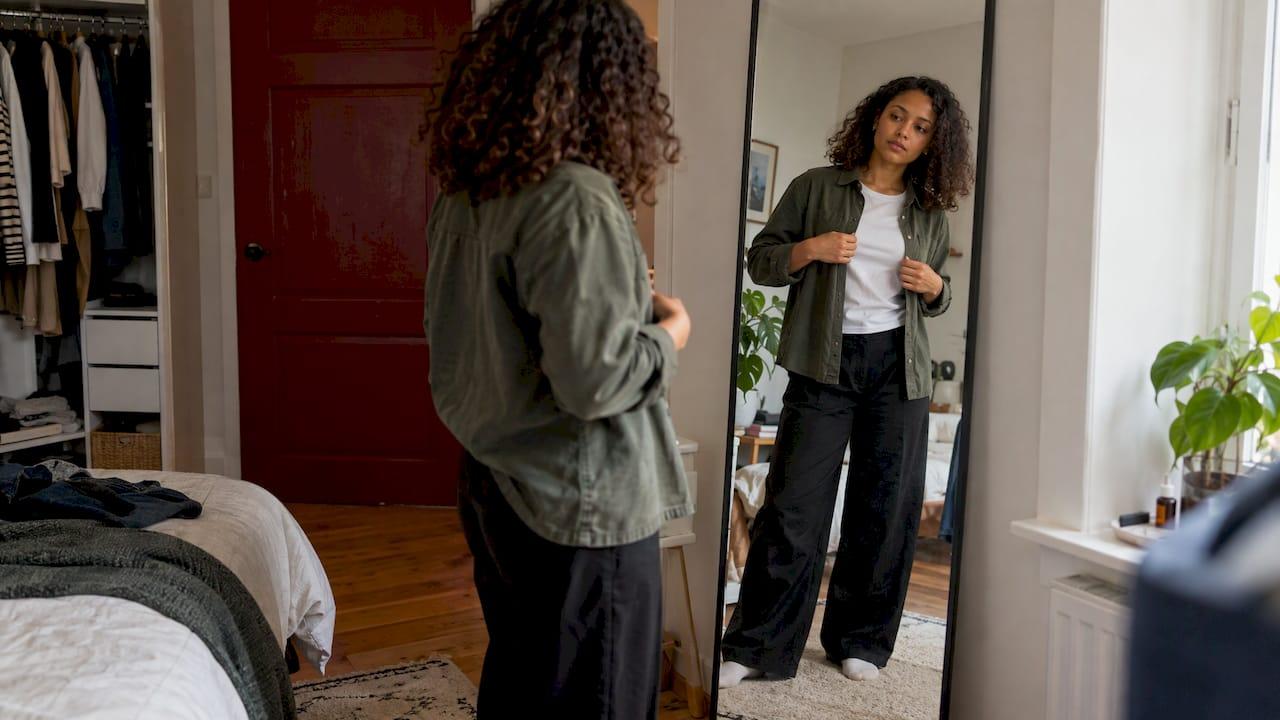
To build a fit, start with one real occasion and one anchor piece you love. Pick a simple color palette around it, balance fitted against roomy, layer from close-fitting to relaxed, then finish with shoes and one or two accessories. You can do all of it with clothes you already own. This guide walks through each step, shows worked examples, and gives you a fix for the moments when a look feels off.
TL;DR
- Start with the occasion (where you're going, the weather, how long you'll be there), then choose one anchor piece you feel good in.
- Keep the palette cohesive: a neutral base plus one controlled accent.
- Balance volume. Fitted on top pairs with roomy on the bottom, or the reverse.
- Layer from closer-fitting pieces to more relaxed ones, and let shoes and accessories set the tone.
- If a look feels too casual, too formal or too bulky, change one element, not the whole outfit.
Table of Contents
- Start With the Occasion, Not the Closet
- Pick an Anchor Piece
- Set Your Color Palette
- Balance Your Proportions
- Layer From the Inside Out
- Finish With Shoes and Accessories
- Make It Yours: Comfort and Personal Style
- Troubleshooting: When a Look Feels Off
- Three Worked Examples
- Choose Pieces That Work Harder
- Our Perspective
- Shop Pieces Built for Mixing
- FAQ
- Sources
Start With the Occasion, Not the Closet
Most bad outfits come from a vague goal. "Something to wear" gives you nothing to build toward. "Coffee, then a walk, then a friend's place, 55 degrees" gives you a brief.
Before you open the closet, answer four questions:
- What are you doing? Sitting at a desk, standing at a show, walking across campus?
- What is the weather? This decides your layers before style does.
- Is there a dress code, spoken or not? Even casual settings have one.
- What do you need to feel comfortable? If you will be sitting for hours, waistbands and fabric matter more than a perfect silhouette.
Then pull a small, visible pile: a few tops, a couple of bottoms, one layer and two pairs of shoes. A short list keeps you from spiraling through every hanger. It also helps to know that a closet refresh does not require a shopping trip. InStyle's casual-outfit guide points out that the practical alternative to impulse buying is revisiting sweaters, button-ups and other loved staples and mixing them in unfamiliar ways.
Pick an Anchor Piece
Every fit needs a starting point. The anchor is the one item you already know you want to wear: a jacket that always gets compliments, jeans that fit perfectly, a hoodie you reach for without thinking. Building from something that makes you feel confident means the rest of the outfit only has to support it.
Once you have the anchor, ask what role the other pieces play:
- If the anchor is loud (a patterned jacket, a graphic piece, bright sneakers), keep everything else quiet. InStyle suggests exactly this for a jeans-and-basic-shirt look: use a colorful or patterned jacket as the focus and keep footwear simple.
- If the anchor is plain (a gray hoodie, a white tee), give another piece the personality: a bold shoe, a textured layer, a cap.
One statement piece per outfit is a reliable rule of thumb. Two can work, but only when they share a color or a mood.
Set Your Color Palette
Color is the fastest way to make separate pieces look like they belong together. You do not need a color-theory degree. You need a base and an accent.
Build on a neutral base
Black, white, gray, navy, olive, tan and denim blue combine with almost everything. Stylist Gadir Rajab, quoted in The Guardian, recommends a core palette, often neutrals or black, then variation in shapes, cuts and fabrics across pants, jackets and tops. That last part matters: when the colors are quiet, texture and cut do the work. Think a cotton tee, a nylon jacket and corduroy pants in the same family of tones.
If your closet leans neutral already, our guide to neutral wardrobe essentials shows how to turn that base into repeatable outfit formulas.
Add one controlled accent
Pick a single place for color: sneakers, a beanie, a bag, a layer. Then repeat it once somewhere small, like a sock, a logo or a cap, so it looks planned. Her World's styling guide also pushes readers to try color instead of always choosing black, which is good advice if your closet has become a sea of one shade.
Tonal dressing is another easy route. Harper's Bazaar suggests using slightly different shades of a similar color to create contrast between layers. A cream tee under a tan overshirt under a brown jacket reads as deliberate, not matchy.
Balance Your Proportions
Proportion is what separates an outfit that looks styled from one that just looks worn. The idea is simple: when one half of the outfit has volume, the other half needs structure.
- Fitted top, wide bottom. Her World gives the example of a fitted top with voluminous pleated trousers. In streetwear terms, think a slim long sleeve with wide-leg jeans or baggy cargos.
- Roomy top, slimmer bottom. An oversized hoodie works with straight or tapered pants so the shape does not disappear.
- Roomy on both, which is common in streetwear. It works when the fabrics are structured, the lengths are deliberate and the shoes have some visual weight to anchor the bottom.
If you are unsure how much room is the right amount, our breakdown of relaxed versus oversized fits explains how to spot the difference before you buy, so you choose volume on purpose rather than by accident.
A quick self-check: stand in front of a mirror and squint. You should be able to see a shape, with a clear shoulder line, a waist or hem you can find, and an obvious place where the leg ends. If it all blurs into one block, tuck, roll, shorten or open something.
Layer From the Inside Out
Layers are where a basic outfit gets depth. The rule is to begin close to the body and get more relaxed as you go outward.
Harper's Bazaar's fashion-editor method begins with a fitted, buttoned base shirt and adds increasingly oversized shirts over it, so proportions expand outward rather than getting bulky at the foundation. It also notes that sleeves can be rolled to add visible drama without adding another garment.
The shirt sandwich
The Guardian describes a formula that works on almost any wardrobe: a close-fitting high-neck layer under a shirt, then a jacket or sweater on top. Three contrasting colors or patterns make the look stronger, while matching two of the layers creates a quieter effect. For a more casual version, the same piece says a hoodie can serve as the top layer, and a silk scarf can replace the polo neck in warmer weather.
For the streetwear take, try:
- A fitted long sleeve as the base.
- A tee or short-sleeve shirt over it.
- A hoodie, overshirt or jacket as the outer layer.
We have a full guide to long sleeve under tee outfits if you want to see how this plays out across different looks. For colder days, hoodie and leather jacket outfits show how to stack heavier pieces without losing your shape.
Layer for the weather, then for style
A layer that looks great but leaves you freezing or sweating will be removed within an hour, and the outfit falls apart. Choose the layer that suits the weather first, then pick the version of it that suits your palette. If you plan to take it off, make sure what is underneath is an outfit on its own.
Finish With Shoes and Accessories
Shoes decide the mood of an outfit more than almost any other piece. The same jeans and tee feel sporty with running sneakers, relaxed with canvas low-tops and sharper with a clean leather pair or boots. Pick shoes last, but pick them deliberately. Our sneakers outfit guide goes through what to wear with each pair.
Then add a small rotation of accessories that do real work. The Guardian's stylists point to a belt, a tote or shoulder bag, simple jewelry, a scarf, a cap or distinctive sneakers as high-leverage items. Each one can repeat a color, change the formality or add personality.
This is also where your overall look comes together beyond clothing. If you are thinking about changing your hair too, it helps to plan a complete hair transformation around the same idea: decide the overall feel first, then choose the details that support it.

Make It Yours: Comfort and Personal Style
A formula can get you a decent outfit. Personal taste is what makes it yours.
Use three style words
Stylist Allison Bornstein told The Cut to choose three style words: one for how you dress now, one aspirational and one emotional. The idea is to keep your style focused without copying another person's aesthetic. For example: relaxed, sharp, playful. When you stand in front of a mirror and the outfit does not match any of the three, you know what to adjust.

Put comfort in the formula
Comfort is not a compromise in casual wear. It is the brief. InStyle presents leggings with a tunic, oversized sweater or oversized button-down as a simple formula that prioritizes ease. It also pairs neutral baggy sweatpants with a tucked-in or cropped sweater and a duster coat when midsection comfort matters most. If sweatpants are your default, our guide to sweatpants outfits that look styled shows how to keep them sharp.
Try it on, then test it
Put the outfit on and sit down, then walk around the room and raise your arms. If you keep tugging at a hem, adjusting a collar or checking the mirror, change something. The best fit is the one you forget you are wearing.
Troubleshooting: When a Look Feels Off
Most outfits are one swap away from working. Use this table to find the swap.
| Problem | Quick fix |
|---|---|
| Too casual | Add a structured layer (an overshirt, a clean jacket) or swap to a smarter shoe |
| Too formal | Switch to a casual top, add a hoodie as the outer layer, or change to sneakers |
| Too much volume | Choose a shorter top, wear the layer open, or do a comfortable tuck |
| Looks flat | Add a texture or a tonal layer in a slightly different shade |
| Feels random | Repeat one color from the shoes or cap somewhere else in the outfit |
| Feels boring | Roll the sleeves, add a cap or bag, or let one piece take the lead |
Change one thing at a time. If you change three, you will not know which one fixed it.
Three Worked Examples
These are formulas, not rules. Swap in what you own.
Weekend errands
- Anchor: a favorite hoodie in gray.
- Bottom: straight dark jeans.
- Shoes: clean white low-top sneakers.
- Accessory: a cap in a color that appears nowhere else.
The palette is neutral with one accent. The hoodie brings volume on top, and the straight leg keeps the bottom half tidy.
Casual evening out
- Base: a fitted black long sleeve.
- Mid layer: a plain tee or open overshirt.
- Outer layer: a leather or structured jacket.
- Bottom: relaxed trousers or dark denim.
- Shoes: black boots or minimal sneakers.
This is the shirt sandwich with an edge. If it is a date, our casual date night outfits guide goes step by step.
Gym to street
- Base: a breathable tee.
- Layer: a zip-up or lightweight jacket.
- Bottom: joggers or tapered sweats.
- Shoes: trainers that can pass as streetwear.
Choose pieces that can change roles. A layer you can zip, open or tie around the waist does more than one job. For more, see our gym to street outfit formulas.
Choose Pieces That Work Harder
If you do want to add to your wardrobe, buy for versatility, not volume. The Guardian's stylists favor pieces that can change role, such as a shirt worn open or buttoned, a cardigan worn as a top or layer, and well-cut trousers or tanks that move between casual and smarter settings. Her World's takeaway is similar: effective styling does not require more clothes.
Before buying, Bornstein suggests asking whether an item makes getting dressed easier, duplicates an existing purpose, requires more purchases, suits your style and could be worn a year from now. If a piece passes those questions, it will earn its place.
Our Perspective
We think a good fit starts with how you want to feel, not with a trend. At Kenny Wade's World, we design casual wear around comfort, style and versatility, because the pieces you reach for most are the ones that work across different occasions.
Our approach comes from the same place as the music: you start with a mood, pick the elements that carry it, and leave out what does not. A hoodie, a clean tee, a jacket and the right shoes can say a lot when the proportions and colors are considered.
We built Kenny Wade's World to join fashion and music culture, so the clothes are meant to move with your day, from errands to a night out. Pick the piece that feels like you, then build around it.
Kenny Wade
Shop Pieces Built for Mixing
If you are ready to add something to your rotation, Kenny Wade Clothing is made for this kind of building: trendy casual wear designed to balance comfort and style and to work across different occasions. Browse the collection at Kenny Wade's World and look for the piece that can be your next anchor.
Fans can also find the artist's music and blog on the same site, so the whole world around the clothes is in one place.
FAQ
How do I put outfits together if I have a small wardrobe?
Choose a neutral base, then change one element at a time: the layer, the shoes or one accessory. The Guardian's stylists note that pieces able to change roles, like a shirt worn open or buttoned, multiply your options. A small closet with a cohesive palette often gives more combinations than a large one without one.
What is the easiest outfit formula for beginners?
Try a fitted top with a relaxed bottom, or the reverse, then add one layer and a pair of simple shoes. Keep the colors in the same neutral family and add a single accent. That covers proportion, color and layering in one outfit.
How do I know if the proportions are right?
Look for a clear shape in the mirror: a defined shoulder, a visible waist or hem, and a clear end to the leg. If one half is voluminous, make the other half more structured or fitted. If everything blurs into one block, tuck, roll a sleeve or open a layer.
Can I wear a hoodie and still look put together?
Yes. Treat the hoodie as an outer or mid layer over a fitted base, pair it with structured pants and keep your palette tight. The Guardian notes a hoodie can be the top layer in a casual shirt sandwich. Our hoodie outfit ideas show more ways to do it.
How many pieces do I need to start?
Not many. Pull a few tops, a couple of bottoms, one layer and two pairs of shoes for a given occasion, and test combinations from that pile. Photograph the ones that work so you can repeat them without starting from scratch.
Sources
- 15 Casual, Chic Outfits You Can Pull Together With Items You Already Own, InStyle
- Colour pops, layers and keys as accessories: how to dress well while owning less, The Guardian
- 8 ways to restyle your wardrobe without buying anything, The Guardian
- How to Style Layers Like a Fashion Editor, Harper's Bazaar
- 5 wardrobe styling tricks for a smarter look, Her World
- TikTok's Allison Bornstein on 5 Tips to Dress Sustainably, The Cut