
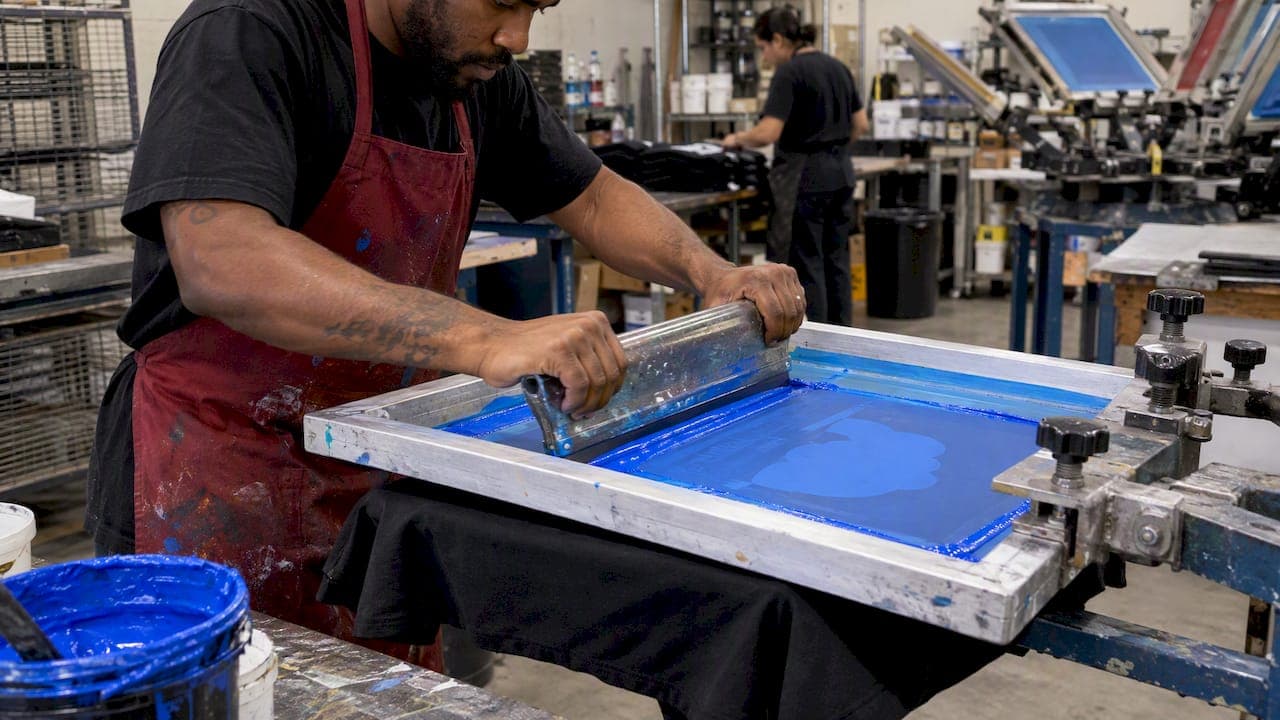
Puff print is a screen-printing effect that makes a design rise off the fabric. A heat-reactive foaming additive sits in the ink, and when the garment goes through curing, the additive activates and expands the ink into a raised, 3D surface. The result feels soft and slightly rubbery, which is why puff shows up so often in streetwear and limited-edition apparel.
TL;DR:
- Mix plastisol puff additive by weight, starting near the middle of the recommended 5% to 15% range, because excess weakens the print.
- Keep puff artwork bold: strokes thinner than about 1–2 mm can lose definition as ink expands, so reserve raised ink for a focal element.
- Use a low mesh count and thick stencil for the deposit, then test curing settings on the actual garment because overcooking can collapse the foam.
- Cotton and cotton blends generally produce the best results, while polyester and some synthetics require testing on the exact garment before production.
- Wash puff prints inside out on a gentle cycle, dry on low heat or hang them, and avoid ironing directly over the raised area.
Table of Contents
- How does puff printing work?
- Which inks and additives make the best puff?
- How should you design artwork for puff?
- What press setup and curing settings give reliable puff?
- How does a puff print feel, wash and last?
- How we use puff texture in streetwear
- Why puff printing rewards patience over hype
- Want puff-style streetwear without the production headaches?
- FAQ
- Sources
How does puff printing work?
Puff ink is a plastisol-based ink modified with a heat-reactive foaming agent. When the print is cured, that agent expands the ink and creates the raised effect. According to Screen Printing Mag, a correctly cured puff print typically rises about 1–2 mm.
The process follows ordinary screen printing. A stencil is built on a mesh screen, the ink with the additive is pushed through onto the shirt, and heat finishes the job. The difference is that attention to deposit thickness and curing decides whether the puff succeeds. Here is what matters most:
- The additive is the active agent. It creates the volume, not the pigment.
- Expansion happens during curing, not on the press.
- A thick ink deposit is required, so low mesh counts and printing technique decide the outcome.
- Puff is a structural change to the ink, not a new color. Printers often note that puff ink can look slightly lighter and more matte after curing than the same color printed flat.
Because the effect depends on a thick, heat-cured deposit, it is a screen-printing specialty. Digital methods do not produce it the same way, a difference we cover in our comparison of DTG and screen printing.
Which inks and additives make the best puff?
Plastisol is the dominant base for puff. It is easy to use, does not dry in the screen, and sits up above the shirt more than water-based ink, which adds dimension. Some water-based puff formulations exist, but they need different handling, including adjusted press and dryer settings.
Mix the additive by weight, not by volume. Weighing keeps each batch consistent, which matters because too little additive gives a flat result and too much weakens the print.
Industry professionals typically recommend 5% to 15% puff additive by weight, a range that balances expansion against structural strength.
Practical notes on materials:
- Start near the middle of the range and adjust after a sample print.
- Cotton and cotton blends give the best results. Polyester and some synthetics need extra testing, and our guide to poly cotton vs cotton helps you judge a blank before you commit.
- Supplier technical sheets, such as the puff additive listings at Jacquard Products, carry product-specific mixing instructions worth following.
How should you design artwork for puff?
Puff rewards bold, simple art. Because the ink expands, tiny gaps close up and thin strokes lose definition. Line work thinner than about 1–2 mm may not reproduce well in puff.
Follow these rules when you build the file:
- Use thick shapes and strokes, and drop fine line detail from any puff layer.
- Pick wide, sturdy letterforms, and run a sample print before committing small type.
- Leave extra space between neighboring elements so expanded edges do not touch.
- Reserve puff for focal areas such as a logo or a single word, and keep the rest of the design flat.
- Plan the color knowing the finished puff may look slightly lighter than the swatch.
Combining puff with flat ink is where the technique pays off. A flat print carries the detail, and the puff layer adds a tactile accent that draws the eye. If you want to see how texture changes an outfit, our graphic tee outfit formulas show how one standout print can anchor a look.
What press setup and curing settings give reliable puff?
A good puff starts at the screen. Lower mesh counts let a thicker ink deposit through, and that thickness is what gives the foaming agent room to create a noticeable 3D effect. Higher mesh counts pass less ink and often produce flat or underwhelming prints.
Press and curing checkpoints:
- Choose a low mesh count and a thick stencil to build the deposit.
- Match squeegee choice, pressure and stroke to the deposit you need.
- Cure long enough to activate the additive, but avoid overcooking, which can collapse the structure.
- Follow the ink manufacturer's documented temperatures, then test conveyor dryer speed and heat on scrap garments.
- Use flash curing sequencing when you layer puff with other colors.
- Print samples, then micro-adjust mesh and additive ratio until the height is even.
Pro Tip: Run your test on the same fabric as the final order. A shirt that puffs well on a heavy cotton blank can behave differently on a thin or synthetic one, and dryer settings rarely transfer cleanly.
Expect puff to cost more than flat printing. Specialized additives, tighter curing control, sampling and thicker deposits add production cost, which is why puff tends to appear on premium and limited runs.
How does a puff print feel, wash and last?
A puff print feels soft but slightly raised, with a gentle rubbery hand. Plastisol bases run a little stiffer than water-based prints, so the feel varies by formulation. Durability comes down to proper curing and a sound ink mix. A properly cured puff print is hardwearing.
To keep the volume:
- Wash inside out on a gentle cycle with cool or warm water.
- Dry on low heat or hang dry, since high heat can break the foam down early.
- Avoid ironing directly on the print, and press from the inside if needed.
- Skip harsh scrubbing and bleach around the raised area.
Our guide to washing hoodies without shrinking them covers general garment care that applies to puff pieces too.
How we use puff texture in streetwear
Raised texture does something flat ink cannot: it creates visual hierarchy you can feel. On a limited drop, a puffed logo gives the piece a tactile signature, and customers notice it before they read a word of the design.

Our approach is to use puff selectively. We put it on a logo or a single focal graphic and leave supporting artwork flat, so the garment stays balanced instead of heavy. Before any capsule release scales up, we test a small run. That check shows how the additive ratio, mesh and cure behave on the actual blank, and it is far cheaper than discovering a weak puff after a full production order.
Why puff printing rewards patience over hype
Most puff advice leans on the ink, as if the right additive guarantees a great result. The research points the other way. Successful puff depends less on the ink and more on the precision of the print setup: a thick deposit from a low-mesh screen is the foundation, and without it even a premium additive cannot deliver.

So my advice is to stop shopping for a magic product and start controlling variables. Get the mesh right first, then the cure, then fine-tune the additive ratio. Design second-guessing comes last, because bold artwork forgives a lot of process sloppiness.
I would also push designers to use less puff, not more. A whole chest of raised ink reads as a gimmick, while one puffed element reads as a choice. Sample early, keep the art chunky, and let the texture earn its spot.
— Kenny Wade
Want puff-style streetwear without the production headaches?
If you would rather wear the look than manage a press, we make it easy. Our clothing at Kenny Wade Clothing is designed to blend comfort and style. Browse the shop at Kenny Wade Clothing to see our clothing.
FAQ
What is puff print in simple terms?
Puff print is a screen-printing technique that creates a raised, 3D design on fabric. A foaming additive in the ink expands when heated during curing, which lifts the print off the garment.
How do you use puff ink?
Mix the puff additive into your ink by weight, print through a low-mesh screen to lay down a thick deposit, then cure with heat so the ink expands. Test on scrap fabric first, because curing temperature and time decide the final height.
How is puff print different from regular screen printing?
Regular screen printing leaves a flat layer of ink, while puff adds an expanding agent that creates volume. Puff also costs more to produce and suits bold art, so we see it mostly on premium and limited-edition apparel.
Does puff print last through washing?
A properly cured puff print is hardwearing. Washing inside out on a gentle cycle and drying on low heat helps it keep its raised look longer.