
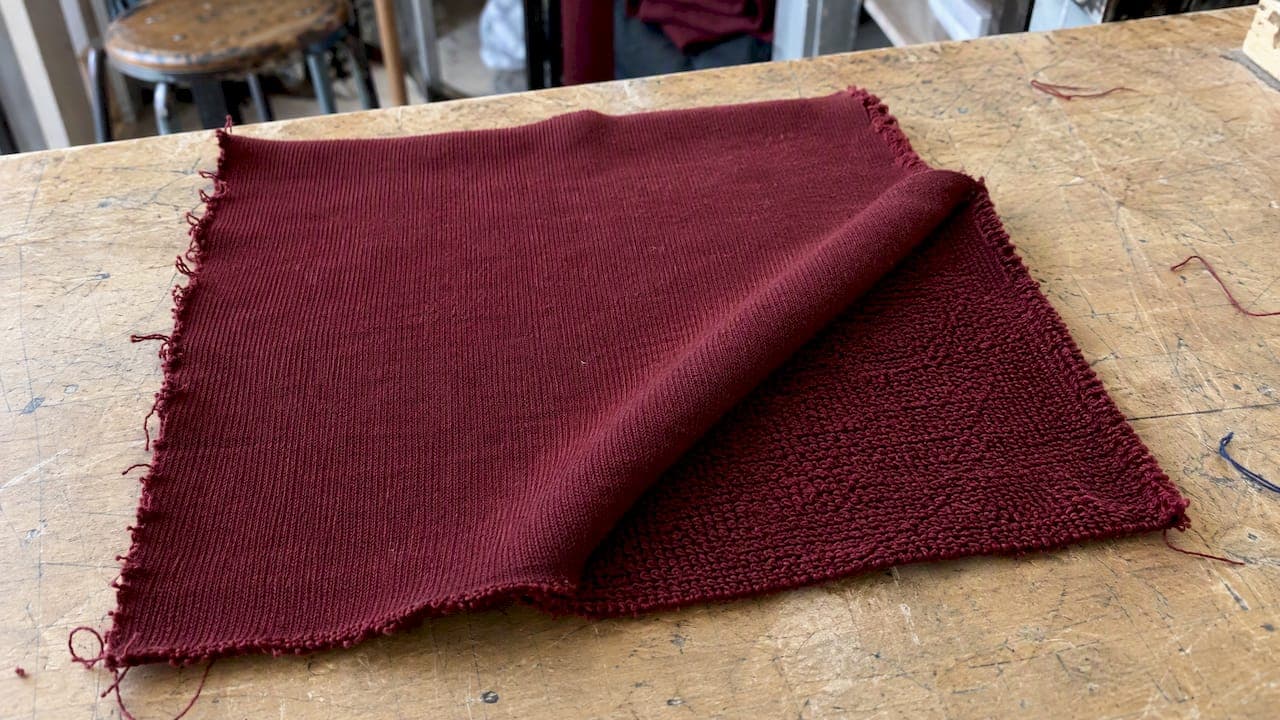
French terry is a knit fabric that is smooth on the outside and looped on the inside. The loops are soft and left unbrushed, which is why a French terry hoodie feels cozy without being heavy. It is the fabric behind most mid-weight sweatshirts, joggers and lounge sets, and it is easy to recognize once you know where to look: turn the garment inside out and you will see tiny loops of yarn.
This guide explains the term, where it comes from, how French terry differs from fleece and from towel-style terry cloth, and what to check before you buy.
TL;DR
- French terry is a knit with a flat face and unbrushed loops on the underside, often sold as loopback cotton.
- It is lighter and more breathable than fleece, and less warm. It suits mid-season hoodies, joggers and loungewear.
- It is usually cotton, often with a little elastane for stretch, and modern blends are common.
- Quality depends on the cotton, the weight (GSM) and how the loops are built, not on the name alone.
Table of Contents
- What French terry means
- How French terry is built
- French terry vs. terry cloth
- French terry vs. fleece
- What French terry feels like and what it is used for
- Can French terry be 100% cotton?
- The downsides of French terry
- Is French terry high quality?
- Caring for French terry
- Our take at Kenny Wade's World
- Shop casual wear built for everyday comfort
- FAQ
- Sources
What French terry means
The name describes a structure, not a fiber. French terry is a knit with a smooth jersey-style face and a set of soft, looped yarns on the back. Gear Patrol's guide to sweatshirt knits describes it as having a flat face with loops on the underside, and notes it is sometimes called loopback cotton. That second name is useful in shopping: if a product page says "loopback," it is talking about the same thing.
The loops do the work. They add body and a bit of warmth, and they act much like the loops on a bath towel, absorbing moisture and sweat. The smooth outer face is what you see: it takes dye and prints well and looks clean on a plain sweatshirt.
The word "terry" is the root of the confusion. Many readers hear it and picture a towel. French terry shares the looped idea but not the construction, as the next sections show.
Where the name comes from
You will see a few origin stories online. The commonly repeated one ties the fabric to northern France, and the "French" in the name points there. Treat the etymology as folklore unless a source gives a documented history, because the word-origin claims vary from page to page. What matters for a shopper is the construction, which is consistent: flat face, looped back.
How French terry is built
French terry is a knit, meaning it is made from interlocking loops of yarn rather than woven threads crossing at right angles. That is why it stretches a little and drapes softly. Threads magazine lists it among terry fabrics with a smooth knitted side and a looped side, commonly used for sweatshirts and cardigans, with moderate stretch.
The loops are formed during knitting by an extra yarn that floats and loops on the back. After knitting, the loops are left alone. That final step is the whole story of how French terry differs from fleece, which starts from a very similar knit and then gets brushed.
Two practical consequences follow:
- The inside looks like tiny stitches or loops. You can see them with the naked eye, and if you run a fingernail across them they feel textured rather than fuzzy.
- The outside looks like a flat knit. It resembles a heavy T-shirt jersey, which is why French terry can look more polished than a fleece hoodie.
French terry vs. terry cloth
This is the question behind many searches, and the answer is short: terry cloth has loops on one or both sides and is made for absorbency, while French terry is a knit with loops on just one side, built for wearing.
Conservators at the Museum of Fine Arts, Boston, in their CAMEO materials entry on terrycloth, describe French terrycloth as having a looped pile on one side and a sheared pile on the other, while ordinary terrycloth has loops on one or both sides and is very absorbent, used in robes and towels. Threads makes the same distinction in plainer words: standard terrycloth has loops on both sides, and French terry has a smooth knitted side and a looped side.
| French terry | Standard terry cloth | |
|---|---|---|
| Loops | One side only | One or both sides |
| Outer face | Smooth, flat knit | Looped, towel-like |
| Typical use | Sweatshirts, joggers, loungewear | Towels, bathrobes |
| Look | Reads as regular clothing | Reads as bath linen |
In short, you would wear French terry out to get coffee. You would not wear a towel.
French terry vs. fleece
Shoppers meet this comparison most often, because hoodies come in both. The difference sits in the finishing. According to Karcem's comparison, French terry is thinner, more breathable and less insulating than fleece because its loops are unbrushed, while fleece is thicker and warmer because its loops are brushed and raised to trap body heat.
| French terry | Fleece | |
|---|---|---|
| Inside | Unbrushed loops | Brushed, fuzzy nap |
| Warmth | Light to moderate | Higher |
| Breathability | Better | Lower |
| Weight | Generally lighter | Generally heavier |
| Best season | Spring, fall, indoor layers | Cold weather |
| Drape | Softer, falls cleanly | Puffier, more volume |
A simple way to choose: if you run warm, live somewhere with mild winters, or want a hoodie for layering under a jacket, French terry is the better daily piece. If you want a cold-weather throw-on that traps heat, pick fleece.
Neither is better in the abstract. They are two finishes of closely related knits, built for different temperatures.
What French terry feels like and what it is used for
Good French terry feels soft on the skin, with a slight cushiness from the loops, and a smooth, even face. It has a moderate stretch that comes from the knit, and more if the fabric includes elastane. It is warm enough to take off a chill, but it breathes, so you do not overheat the minute you step indoors.
The usual products:
- Sweatshirts and crewnecks. The classic use. Gear Patrol presents French terry as a sweatshirt fabric.
- Hoodies. Especially mid-weight hoodies you can wear from spring through fall.
- Joggers and sweat shorts. The smooth face keeps them from looking like gym gear.
- Loungewear sets. Matching tops and bottoms that can go to the store or a casual dinner.
- Cardigans and light jackets. The drape suits open-front pieces.
If you like to dress these up, our guide to elevated loungewear outfits that work outside the house shows how a clean French terry crew or jogger pairs with sneakers and a structured outer layer.
Can French terry be 100% cotton?
Yes. Gear Patrol reports that French terry is most commonly offered in 100% cotton, and may include added elastane for stretch. Cotton gives the loops their absorbent, soft hand.
Blends are now common too. Pura Fabric's practical guide notes that traditional French terry was almost exclusively cotton, while today cotton-polyester, cotton-modal and cotton-Lycra versions exist, which can improve durability, softness, stretch or recovery.
Here is how to read a fiber label:
- 100% cotton: the softest, most natural feel. It can shrink a little and may hold wrinkles.
- Cotton with 2 to 5% elastane: the stretch and shape recovery improves, which helps joggers keep their knee and waist shape.
- Cotton-polyester: typically more durable and more resistant to shrinking, with a slightly less soft hand.
- Cotton-modal: a smoother, drapier feel.
To understand how those fiber choices behave after washing, see our comparisons of poly cotton vs. cotton and tri-blend vs. cotton shrinkage.
The downsides of French terry
It is a very good everyday fabric, but it has limits, and it is better to know them before you buy.
- Less warm than fleece. Without a brushed nap, it does not trap as much heat. In real cold you will want a coat over it.
- Heavier than jersey. A French terry tee or top is thicker than a single-jersey T-shirt and feels warmer in summer heat. Pura Fabric also says it is less breathable than lightweight single jersey.
- It can pill. The looped back can pill, especially when the cotton is lower-quality short-staple or in high-friction spots like underarms and inner thighs.
- Not a performance fabric. Cotton absorbs sweat, so during hard workouts the fabric can get damp and dry slowly. For a run, choose a synthetic. For the walk to the gym, a French terry hoodie is great.
None of these are deal-breakers. They are reasons to match the fabric to the use.
Is French terry high quality?
The name does not tell you. French terry is a construction, and quality depends on what goes into it. Pura Fabric's guide advises checking GSM, loop length and height, and fiber quality, and says long-staple cotton and well-built blends can feel luxurious and last. Use these checks when you shop:
Check the weight
GSM means grams per square meter, a measure of fabric density. A heavier GSM is not automatically better: a dense, stiff fabric can feel clunky, and a light one can feel flimsy. Match weight to season. Our explainer on what GSM in clothing really tells you about quality goes deeper, and our note that stitch quality beats GSM is worth reading before you pay extra for "heavyweight."
Look at the fiber
Smoother, longer cotton fibers pill less. Terms such as combed or ring-spun point toward a smoother yarn. Our guide to ring-spun cotton vs. regular cotton explains what those words do and do not promise.
Inspect the inside
Turn the garment inside out. The loops should be even and tidy, with no bald patches or stray snags. Rub a spot gently with your thumb: heavy fuzzing right away in the store is a bad sign.

Check the construction
Look at seams, cuffs and hem bands. Ribbed cuffs should bounce back when you stretch them. Flat, even stitching at the shoulders and neckline matters more than the fabric name on the tag.
If you want a second opinion on building a wardrobe of repeat buys, these stylist notes on rebuying pieces give a useful frame for deciding what is worth buying again.
Caring for French terry
A few habits keep it looking sharp:
- Wash in cold or warm water, inside out, to protect the face and reduce pilling.
- Skip fabric softener, which can coat cotton fibers and flatten the loops over time.
- Dry on low heat or hang to dry. High heat is what shrinks cotton the most.
- Wash with similar fabrics, not rough items like jeans or towels, to reduce friction.
Always follow the care label on the garment. It reflects how that specific fabric was finished.
Our take at Kenny Wade's World
We think of French terry as the most honest casual fabric. It does not need a special occasion or a weather forecast. You can wear a crewneck on a morning errand, a late studio session or a night out with friends, and it looks right every time.
That fits how we design: clothing that mixes comfort and style and stays versatile enough for different occasions. When we look at a fabric, we ask three questions. Does it feel good on the skin after an hour? Does it keep its shape after many washes? Can it work in more than one outfit? French terry usually answers yes to all three, when the cotton and the construction are right.
We also think buyers over-focus on one number. A tag that says a high GSM can still be a poorly knit piece. Look at the whole garment: the loops, the seams, the cuffs, the fit. Fabric is part of the story, and the way a piece is made is the rest.
— Kenny Wade
Shop casual wear built for everyday comfort
If you want to see how comfort and style come together in our pieces, browse the full range of Kenny Wade clothing. Our casual wear and branded merchandise are made for fashion-forward people and for fans who like their wardrobe to carry some of the music with it.
If you are still deciding between silhouettes, our comparison of hoodie vs. sweatshirt will help you pick by neckline, pockets and fabric.
FAQ
What is the difference between terry and French terry?
Terry cloth has loops on one or both sides and is made to absorb water, which is why it is used for towels and robes. French terry is a knit with a smooth face and loops on one side only, designed for clothing like sweatshirts and joggers. It looks and feels like normal apparel, not bath linen.
Is French terry warmer than fleece?
No. Fleece is brushed, which raises a fuzzy nap that traps more body heat. French terry keeps its loops unbrushed, so it is thinner, breathes better and insulates less. It is a better choice for mild weather and layering.
Can French terry be 100% cotton?
Yes, and that is its most common form. Many versions add a small amount of elastane for stretch, and blends with polyester or modal are also sold. Check the fiber label to see what you are getting.
Does French terry pill?
It can, particularly when it is made from lower-quality short-staple cotton or when it rubs in high-friction areas. Better yarns, sensible washing (inside out, no heavy fabric softener) and avoiding rough companions in the machine all reduce pilling.
Is French terry good for summer?
Lightweight versions work for cool evenings and air-conditioned rooms, and the fabric breathes better than fleece. In real heat, though, a single-jersey T-shirt is lighter and more comfortable. Our T-shirt fabric types guide can help you choose.
Sources
- Before You Buy Your Next Sweatshirt, Know Your Knits, Gear Patrol
- How to Sew with Terrycloth, Threads
- Terrycloth, CAMEO, Museum of Fine Arts, Boston
- Two-Thread vs Three-Thread: French Terry vs Fleece, Karcem
- French Terry Knit Fabric: A Practical Guide, Pura Fabric