
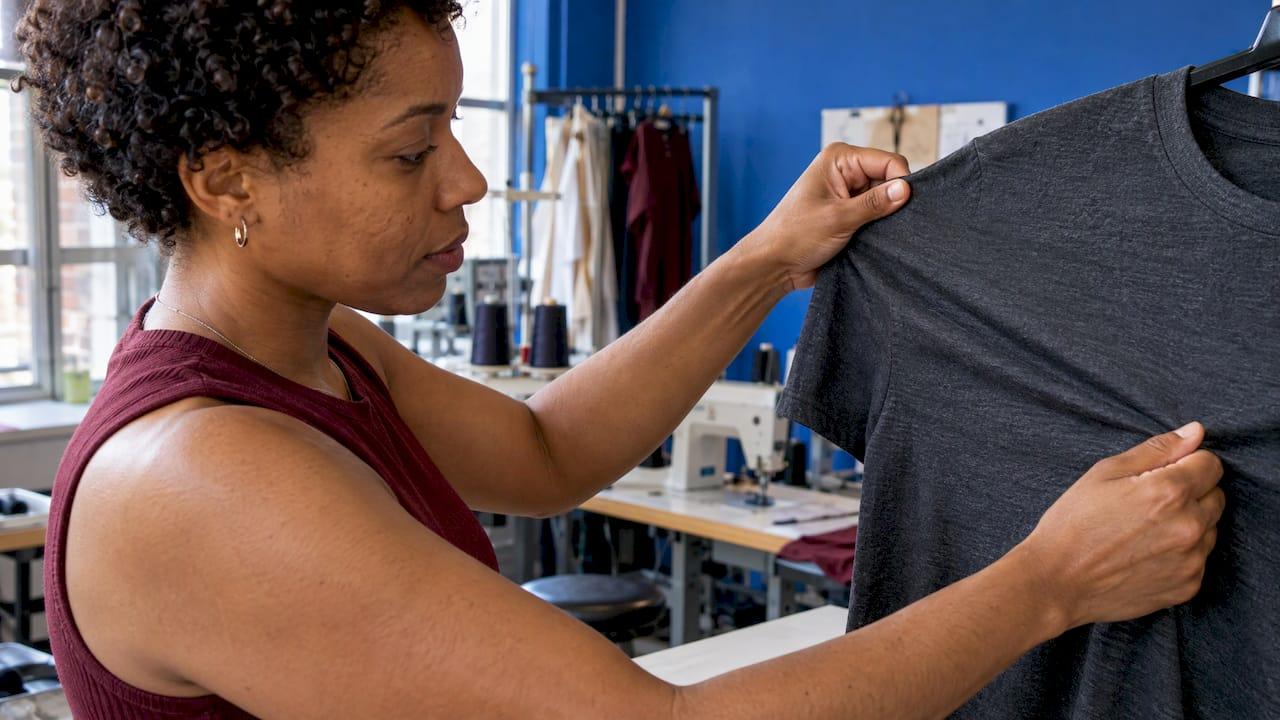
Jersey knit is a soft, stretchy fabric made by looping a single yarn into connected rows on one set of needles. That construction gives it a smooth face, a slightly textured back and a natural give that woven cloth doesn't have. It's the fabric behind most T-shirts, plenty of dresses and a lot of loungewear, which is why the tee you reach for first is probably jersey.
This guide explains what jersey is, how to recognize it, which fibers change how it feels, and how to wash it so it keeps its shape.
TL;DR
- Jersey is a knit, not a weave: one yarn is looped on a single set of needles, so the fabric stretches and drapes softly.
- Single jersey has a smooth V-pattern face and a looped back. Its cut edges roll, and it stretches most across the width.
- Fiber decides the feel: cotton for softness, polyester for durability, viscose for drape, and a little elastane for recovery.
- Common types are single jersey, double (heavy) jersey, interlock and stretch jersey. Each suits different garments.
- Wash cold, tumble dry low or lay flat, and iron on low only if you need to.
Table of Contents
- What jersey knit actually is
- How jersey knit is made
- How to recognize jersey knit
- Fibers: what jersey is made of and how it feels
- Types of jersey knit
- What jersey knit is used for
- Why people love jersey: the real advantages
- Choosing a jersey piece that lasts
- How to wash and care for jersey knit
- Perspective
- Find comfortable casual wear at Kenny Wade's World
- FAQ
- Sources
What jersey knit actually is
A knit is built by interlooping yarn into connected loops. A woven fabric is built by crossing two sets of threads at right angles. That difference explains almost everything you notice about jersey: the stretch, the softness and the way it hangs on the body.
Jersey is the simplest and most common knit. Textile researchers at Pratt describe it as knitted with a single yarn on a single set of needles, with cut edges that roll and stretch across its width. Other names you'll see for the same fabric are plain knit and single knit.
The name has a history. Jersey was originally made from wool, and today it's made from cotton, synthetics and blends as well. The structure is what defines it, not the fiber. A cotton jersey, a polyester jersey and a viscose jersey are all jerseys because of how the yarn is looped.
How jersey knit is made
Jersey is a weft knit. A single yarn feeds across the width of the fabric and forms a row of loops, called a course. Each new row is pulled through the loops of the previous one. The vertical columns that result are called wales.
In single jersey, every loop is drawn through to the same side of the fabric. That's why the two sides look different:
- The face (technical face): smooth columns of small V shapes.
- The back (technical back): rows of semicircular loop heads, which feel a little bumpier.
Oregon State University's textile materials describe the same structure: loops facing only one side, with the V showing on the face and the horizontal part of the loop on the back. The same document notes that it has the greatest stretch in the crosswise direction and is generally used in casual, semifitted clothing.
Because the stitch is simple and the machines are efficient, single knits are among the most productive knits to produce. That's part of why jersey tees can be both comfortable and accessible.
How to recognize jersey knit
You don't need a lab. Check four things.
- Two different sides. Look at the face for fine lengthwise ribs and at the back for small semicircular loops. Threads magazine describes jersey as having distinct right and wrong sides.
- Crosswise stretch. Pull the fabric from side to side, then up and down. Jersey gives much more across the width. CottonWorks notes that width extensibility is about twice the length extensibility.
- Curling edges. Cut jersey curls toward the right side along the top and bottom edges, and the sides curl toward the back, as one detailed single jersey breakdown explains. A tee hem is stitched precisely so you never see this.
- Unraveling. Because the yarn runs horizontally, a cut edge can unravel from both ends, so finished seams matter.
Why it stretches without elastic
The stretch comes from the loops, not the yarn. Pull the fabric and the loops elongate and shift. Woolwise's textile lecture notes explain that jersey extends in both directions, but the lateral extension is about twice the longitudinal extension, because a loop pulled sideways can open by its whole length but only by half when pulled lengthwise. That's why a plain cotton tee moves with you even when it contains no stretch fiber at all.
Fibers: what jersey is made of and how it feels
Jersey can be knitted from cotton, polyester, viscose or rayon, modal, wool, linen and blends of these. Many pieces add a small percentage of elastane (also sold as spandex or Lycra) for extra recovery. Here's how the main choices tend to behave.
| Fiber | What you notice | Best for |
|---|---|---|
| Cotton | Soft, breathable, easy to dye | Everyday tees, loungewear, baby clothes |
| Polyester | Durable, resists shrinking, wicks moisture | Activewear, performance tees |
| Viscose / rayon | Fluid drape, silky hand | Dresses, drapey tops |
| Modal | Very soft | Premium basics, layering pieces |
| Wool | Warm yet breathable | Base layers, knitwear-style tops |
| Cotton + elastane | Holds shape, fitted stretch | Fitted tees, leggings, dresses |
Cotton is the most familiar choice. Cotton jersey feels soft and absorbs moisture as a base for everyday garments, and it takes dye well. A small amount of elastane changes recovery noticeably: even 2 to 5 percent elastane improves how well a jersey springs back after being stretched.
Fiber content also changes comfort in measurable ways. A 2018 peer-reviewed study of single jersey fabrics found that polyester/spandex had the highest air permeability and the lowest stretch recovery, while rayon/spandex and polyester/spandex showed no wicking at all. Weight matters too: a 2020 follow-up study found that a thinner, lighter jersey (96% cotton, 4% spandex) had higher air permeability but lower horizontal wicking than a thicker, heavier fabric. The takeaway is practical: judge a jersey by fiber and weight together, not by the word "jersey" alone.
If you want to go deeper on how fabric choice shapes a tee, we break it down in our guide to T-shirt fabric types, and in ring spun cotton vs cotton for the yarn side of the story.
Types of jersey knit
Jersey isn't one fabric. It's a family, and the type changes weight, stretch and how the garment looks on the body.
Single jersey
The classic. Lightweight, smooth on the face, textured on the back, with the curling edges described above. Wikipedia's overview of the family lists it as the type most often used for T-shirts. It drapes more softly than the double-knit types, and it's common in tees, casual tops and lightweight dresses where softness and movement matter more than edge stability.
Double jersey (heavy jersey)
Made with two sets of needles, double jersey is thicker and more stable, smooth on both sides, and it doesn't curl at the edges. It's less stretchy than single jersey and suits jackets, skirts and structured dresses. The family also includes interlock, jacquard, clocqué and stretch jerseys.
Interlock
Interlock is made of two layers knitted together so both faces look identical and smooth. It's thicker and more stable than single jersey, which makes it a popular choice for premium tees, baby clothes and sportswear. We compare the two directly in jersey knit vs interlock.
Stretch jersey
Stretch jersey is any jersey blended with elastane or spandex. It's common in activewear and form-fitting pieces because it springs back after movement.
Matte jersey
Matte jersey is a lightweight knit with a dull luster, made with fine crepe yarns that give a pebbly texture. Threads magazine notes it grazes the body rather than clinging, keeps its springy shape and resists wrinkling, which is why it's a favorite travel fabric.
What jersey knit is used for
Jersey shows up wherever comfort is the first requirement. Pratt's textile lab lists T-shirts, dresses and activewear, plus home textiles like bed linens. Woolwise adds that the jersey stitch is the starting point for all knitted structures and is widely used in sweaters, dresses and sport shirts.
Typical uses by type:
- Single jersey: tees, tank tops, casual dresses, lightweight layering pieces.
- Heavy or double jersey: structured dresses, skirts, jackets.
- Interlock: premium tees, polo-style shirts, kidswear.
- Stretch jersey: leggings, fitted dresses, athletic tops.
- Viscose or modal jersey: drapey tops and soft loungewear.
CottonWorks points out that single knits tend to be used for garments worn close to the body, and that fiber and yarn choices change the weight and drape.
Why people love jersey: the real advantages
The loop structure does a lot of work for the wearer. Woolwise's textile notes name comfort and retention of appearance as the major wearer benefits of knits, with outstanding stretch and recovery and generally no ironing needed. The same notes explain that a knitted structure is thicker than a woven one in terms of yarn diameters, which creates tiny pockets of air and good insulation in still air.
In practice that means:
- Softness against the skin. Fine yarns and a smooth loop structure feel gentle.
- Easy movement. The fabric gives with you, so a tee doesn't bind at the shoulders.
- Breathability. Jersey is highly absorbent and breathable, which makes it a natural base layer under heavier pieces.
- Soft drape. Jersey hangs and moves rather than standing away from the body.
- Low maintenance. Most jersey pieces go in the washing machine and need little or no ironing.
Choosing a jersey piece that lasts
If you're shopping, a few checks make a real difference.
Look at the weight. A lighter single jersey drapes and breathes. A heavier one feels sturdier and holds its shape. Neither is better in general; it depends on whether you want a summer tee or an everyday staple.
Check the fiber blend. A plain cotton jersey is soft and breathable. If you want a fitted garment to hold its shape wash after wash, a cotton blend with a little elastane is the standard route. Polyester blends add shrink resistance and are a good fit for sports. We go through the trade-offs in poly cotton vs cotton and tri blend vs cotton.
Look at the finish. Pre-shrunk cotton keeps its fit better. Cotton jersey that isn't pre-treated can shrink slightly in the first wash, so check the label and size to the fit you want.
Check the seams and hems. Because jersey can unravel and curl when cut, clean finishing at the hem, neckline and sleeves is a good sign of care in construction.
Match the type to the job. Single jersey for lightweight comfort, interlock or heavy jersey when you want a smooth, stable surface on both sides.

How to wash and care for jersey knit
Jersey is an easy-care fabric when you treat it kindly. The Fabric Atlas care summary for jersey is simple: machine wash cold with like colors, tumble dry low or lay flat to dry, and iron on low if necessary.
A few habits protect shape and color:
- Wash cold. It's gentler on fibers and on any printed graphics.
- Turn garments inside out. This protects the face from rubbing and keeps prints in better condition.
- Skip the heat when you can. Woolwise notes that dimensions are retained best by drying a washed garment lying flat, and that the loop structure makes knits susceptible to snagging, so avoid zippers and rough hardware in the same load.
- Don't hang heavy wet pieces. Cotton absorbs water and the weight can stretch a wet knit out of shape, so dry flat or fold over a rack.
- Mind elastane. If your jersey contains it, keep the dryer on low, because high heat is hard on stretch fibers.
For heavier knits and fleece-style pieces, our guides to washing hoodies without shrinking them and to French terry cover the same principles for thicker fabrics.
Perspective
When we design casual wear, comfort is the starting point, because a piece you reach for every day has to feel good first and look good second. Jersey knit is a big reason that's possible: soft, easy to move in and easy to wear from a morning errand to a night out.
At Kenny Wade's World we think of clothes the way we think of music: they should fit your life, not the other way around. That's why we build around comfort, style and versatility, so a single piece works across occasions instead of sitting in a drawer waiting for one.
Knowing your fabrics makes you a sharper shopper. Once you can spot a single jersey from an interlock, or tell a cotton from a blend by feel and label, you can pick the pieces that suit how you actually live. That's the kind of fashion we want to help our community enjoy.
Kenny Wade
Find comfortable casual wear at Kenny Wade's World
If you came here to understand jersey because you're shopping for everyday pieces, that's what we do. Kenny Wade's World brings together casual wear designed around comfort, style and versatility, with merch that carries Kenny's musical identity.
Browse the full range at Kenny Wade Clothing and find something that fits the way you dress. If you'd like to know the person behind it, meet Kenny Wade, the musician, blogger and fashion innovator behind the brand.
FAQ
Is jersey knit the same as a T-shirt fabric?
Not exactly, but most T-shirts are jersey. Jersey is a type of knit, and it's among the most common knits used in tees. Some tees use other structures, such as interlock or rib, so the label and the feel of the fabric tell you more than the word "tee".
Does jersey knit stretch?
Yes. The loops let the fabric stretch, mostly across the width, even when the fiber is plain cotton. Adding a small amount of elastane improves how well it springs back, which is why fitted pieces often include it.
Is jersey knit warm or cool?
It depends on weight and fiber. Light single jersey in cotton or viscose is breathable and works well in warm weather. Heavier or wool jerseys add warmth, and jersey also works as a base layer under thicker clothing.
Why does jersey curl at the edges?
It's the single-sided loop structure. The face and back are different, so the fabric relaxes toward its right side at the top and bottom edges when cut. Double-knit types such as interlock don't curl, and finished hems on a garment keep it flat.
How do I keep jersey from shrinking?
Wash in cold water and dry on low heat or lay it flat. Untreated cotton jersey can shrink a little the first time, so check whether the piece is pre-shrunk. Our guide to washing hoodies the right way applies the same habits to thicker knits.
Sources
- TRL - Knits, Pratt Textile Research Lab
- Jersey: definition, examples and textile uses
- The Structure of Woven and Knitted Fabrics, Oregon State University
- Formation and Properties of Knitted Structures, Woolwise
- Single and Double Knits, CottonWorks
- How to Identify Knit Fabrics, Threads
- A Little Bit About Single Jersey, Pattern Scissors Cloth
- Effect of Fiber Content on Comfort Properties of Single Jersey Knits
- Comparison of Comfort Properties of Jersey and Interlock Knits
- Jersey (fabric), Wikipedia
- Taming Jersey Knits, Threads
- Jersey care guide, Fabric Atlas
- What Is Jersey Fabric?, Clothing Manufacturer guide
- Jersey Fabric: Properties and Uses, Sewport