
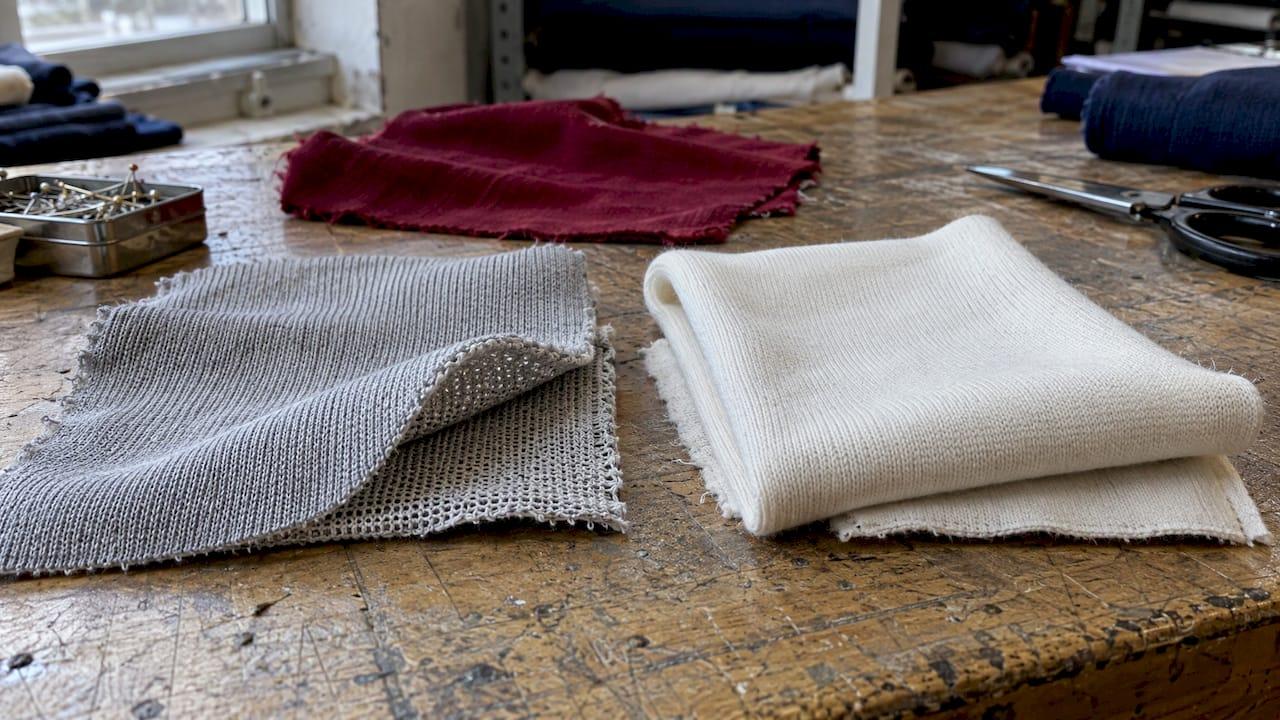
Jersey is a single knit: one yarn, one set of needles, loops running in one direction. Interlock is a double knit: two ribbed layers knitted into one fabric that looks the same on both sides. That one construction difference explains almost everything else. Interlock is thicker, steadier and does not curl. Jersey is lighter, stretchier across its width and breathes more easily. Below you will find how each is made, how they behave when you wear, wash and sew them, and how to tell which one you are holding.
TL;DR
- Jersey knit is a single knit with a different face and back. It is light, stretchy across the width and curls at cut edges.
- Interlock is a double knit that looks identical on both sides. It is heavier, smoother and more stable, and it lies flat when cut.
- Jersey suits warm weather and everyday tees. Interlock suits cooler weather, polos, premium tees and close-fitting pieces.
- Typical weights: single jersey around 120 to 180 GSM, interlock around 180 to 280 GSM.
- Fast test: look at the back of the fabric. Different back means jersey. Same on both sides means interlock.
Table of Contents
- What jersey knit means
- What interlock fabric means
- Jersey knit vs interlock side by side
- Stretch, recovery and shape
- Warm weather vs cool weather
- Which fabric for which garment
- How to tell jersey from interlock at home
- Sewing with each fabric
- Quick buying guide
- Perspective: why fabric choice is a style choice
- Shop casual wear built around comfort and style
- FAQ
- Sources
What jersey knit means
"Jersey" names a knit structure, not a fiber. A jersey can be cotton, polyester, a blend, or any of those with stretch yarn added. The structure is simple: a single yarn knitted on a single set of needles, so the loops run in one direction. That is why you may see it called plain knit or single knit.
You can see the structure with your own eyes. The right side shows fine ribs running lengthwise, while the reverse shows semicircular loops. Hold a basic cotton tee up to the light and you will find both.
Jersey is the knit most people already wear. It is the most common knit in garments like T-shirts, underwear and swimwear, and it comes in a range of weights depending on the job. It has a soft hand and a fluid drape, which is why it moves so well on the body.
Two habits of jersey are worth knowing:
- It curls. When cut, the edges roll, usually toward the right side. This is normal, and finished garments are hemmed so you never see it.
- It stretches mostly across the width. Crosswise extensibility is roughly twice the lengthwise figure, so a tee gives side to side and holds its length.
What interlock fabric means
Interlock is a double knit. Its name comes from two 1x1 rib fabrics being interlocked into one. It is made on two sets of needles, which lock the purl sides together, producing a thicker, less stretchy fabric than regular jersey.
The result is a fabric with the same smooth face on both sides, sometimes described as reversible. It has fine lengthwise ribs, almost no lengthwise stretch and fairly good shape retention. Because of its stability, it does not curl at the edges, which makes it calmer to cut and sew.

Quality matters here. When interlock is knitted with combed cotton yarns, it can be very soft. It turns up in dresses, baby clothes and close-to-the-body pieces like turtlenecks.
Jersey knit vs interlock side by side
| Feature | Single jersey | Interlock |
|---|---|---|
| Construction | One yarn, one set of needles | Two interlocked 1x1 rib layers, two sets of needles |
| Face vs back | Different | Identical |
| Typical weight | 120 to 180 GSM | 180 to 280 GSM |
| Crosswise stretch | 30 to 50% | 20 to 30% |
| Edges when cut | Curl | Lie flat |
| Thickness | Thinner | Heavier and thicker |
| Pilling | Higher tendency | Lower tendency |
| Best known for | Everyday tees, underwear, swimwear | Polos, premium tees, children's wear, turtlenecks |
Treat the numbers as typical ranges, not guarantees. Fiber, yarn quality, spandex content and finishing all move them. If you want a refresher on what the weight figure means, our guide to what GSM tells you about quality covers it.
Stretch, recovery and shape
It is tempting to say jersey stretches more, so jersey is better for fitted clothes. It is not that simple.
At the same yarn and spandex content, interlock has slightly lower stretch, but it often shows better recovery and dimensional stability in wear and after washing. In plain terms, interlock gives a little less, but it comes back to shape more reliably.

Jersey, for its part, can have quirks. It can run if snagged. Some jerseys also twist after washing, a problem known as spirality, where the vertical ribs skew. Choosing a well-made fabric from good yarn and washing as the label says keeps this in check.
If you have ever wondered why a stretch fabric can feel supportive rather than restrictive, this look at how stretchy fabric supports comfortable recovery shows how much fabric behavior matters when clothing has to work with the body, not against it.
Warm weather vs cool weather
This is where the two fabrics separate most clearly for everyday wear. A comfort study comparing both structures suggested interlock for colder weather because of its higher thermal insulation, and single jersey for active sportswear and summer garments because of its better moisture management.
The logic is easy to follow. Jersey is thin with plenty of tiny gaps for air to move. Interlock is dense, so it holds warmth. The same study notes that the thick structure of interlock provides both warmth and comfort.
A practical way to use this:
- Hot, humid days, travel, workouts: lightweight jersey.
- Spring and fall layering, polos, nicer tees: either, depending on how structured you want the piece to look.
- Cold days, base layers, a tee that has to look sharp on its own: interlock.
Note that weight is only half the picture. Fiber content changes how both fabrics feel in heat, and our breakdowns of poly cotton vs cotton and tri blend vs cotton show how blends shift comfort and shrinkage.
Which fabric for which garment
T-shirts
Both work. Jersey gives the relaxed, drapey, breathable tee most people think of. Interlock gives a smoother, heavier, more polished one. Interlock is a preferred choice for polo shirts, premium T-shirts and children's wear. For more on the options, see our guide to T-shirt fabric types.
Dresses, skirts and turtlenecks
Interlock is recommended for T-shirts, turtlenecks, casual skirts and dresses, and children's wear. Its stability means the garment holds a clean line.
Activewear and leggings
The picture is mixed, and that is fine. One academic comparison notes that interlock knits have four-way stretch and suit exercise apparel and tight-fitting dresses, including leggings. The same research points to single jersey for hot-weather sportswear thanks to moisture management. Match the fabric to the conditions: jersey for heat, interlock for cooler sessions.
Hoodies, sweatshirts and joggers
These often use other structures, such as fleece or terry, rather than plain jersey or interlock. If you are comparing those, read our pieces on French terry, hoodie vs sweatshirt and heavy vs midweight hoodies.
How to tell jersey from interlock at home
You do not need a lab. Try these steps on any knit garment or swatch.
- Flip it over. Compare face and back. Fine vertical ribs on the front and a looser, looped back mean jersey. Two matching faces mean interlock.
- Check a cut edge or hem allowance. If a raw edge rolls up, it is behaving like jersey. If it lies flat, it is likely interlock.
- Stretch it both ways. Pull across the width, then along the length. Jersey gives noticeably across and little along. Interlock gives less overall and bounces back firmly.
- Hold it to the light. Interlock looks denser and more opaque. Jersey often lets more light through, depending on weight.
- Feel the thickness. Pinch it between two fingers. Interlock feels like it has more substance at the same softness.
Fiber blend, finish and dye can blur these clues. When in doubt, the label and the product description are the most reliable guide. For a related hands-on method with fibers, try our home tests for poly cotton vs cotton.
Sewing with each fabric
If you sew, the difference is felt at the table. Interlock is the friendlier choice for beginners. One sewing guide calls it generally the easiest knit to work with, stable with good stretch and recovery, though some interlocks offer little vertical stretch where four-way stretch is needed. A university extension guide agrees that interlock knits are heavier, thicker and easier to sew than jersey.
Jersey takes a bit more care. Because edges curl, pin generously, cut on a flat surface and use a stretch needle. Patterns also matter: jersey with crosswise stretch needs a pattern designed for it or adjustments.
Quick buying guide
Use this when shopping for finished clothes:
- You want airy, easy and light: choose jersey, ideally in a mid weight so it does not go see-through or lose shape.
- You want structure, a smoother face and more warmth: choose interlock.
- You want a tee that wears for years: look at yarn quality before structure. Both fabrics improve with good yarn, as our look at ring spun cotton explains.
- You care about pilling: interlock has a lower pilling tendency in typical comparisons.
- You want care simplicity: knits in general are comfortable to wear, easy to care for and shed wrinkles well.
For the wider picture on styles, materials and care, our ultimate guide to T-shirts is a good next read.
Perspective: why fabric choice is a style choice
We think about clothing the way we think about music: the details you can feel matter as much as the ones you can see. Knit structure is one of those details. Jersey and interlock are not a good one and a bad one. They are two answers to two different questions about how a piece should move, drape and hold up.
At Kenny Wade's World, our approach is built on comfort, style and versatility, with every piece meant to work across different occasions. That is why we look past a single number. Weight, stitch quality, yarn and construction all work together, and we talk about them openly on our blog so you can shop with confidence.
Our advice: decide when and where you will wear the piece first. Hot day and a lot of movement, think light and breathable. Cooler night and a sharper look, think dense and smooth. Then let your own taste do the rest.
Kenny Wade
Shop casual wear built around comfort and style
If you want to see how these ideas translate into everyday pieces, our collection is built around comfort, style and versatility, with music culture woven in. Browse the full range at Kenny Wade Clothing.
You can also learn more about the artist behind the brand on the Kenny Wade about page.
FAQ
Is interlock the same as jersey?
No. Both are knits, but jersey is a single knit with a different face and back, while interlock is a double knit with identical sides. Interlock is thicker, more stable and does not curl at the edges. Jersey is lighter and stretches more across its width.
Is interlock better for summer or winter?
Interlock's density gives it higher thermal insulation, so researchers suggest it for colder weather. Single jersey is recommended for summer garments and active sportswear because of better moisture management. A lightweight interlock can still be worn in mild weather.
What does "interlock material" mean?
It means a fabric made by knitting two ribbed layers together so they interlock. The outcome is a smooth, soft surface on both sides, a firm hand and no curling at cut edges. It can be made from cotton, polyester or blends.
Is jersey knit stretchy?
Yes, mostly across the width. Jersey stretches across its width unless the threads are elastic, and it has little lengthwise stretch. The structure itself creates the stretch, so adding elastane is optional and changes the amount.
Which is easier to sew?
Interlock. Its stability and flat edges make cutting and stitching more forgiving, so it is a common recommendation for first-time knit sewers.
Sources
- TRL: Cut & Sew Knit Exploration (Pratt Institute)
- Single & Double Knits (CottonWorks)
- How to Identify Knit Fabrics (Threads)
- Sewing With Knit Fabric (University of Nebraska extension)
- Jersey vs Interlock Knit comparison
- Comparison of Comfort Properties of Jersey and Interlock Fabrics
- Understanding Interlock Fabric
- Understanding Knit Fabrics