
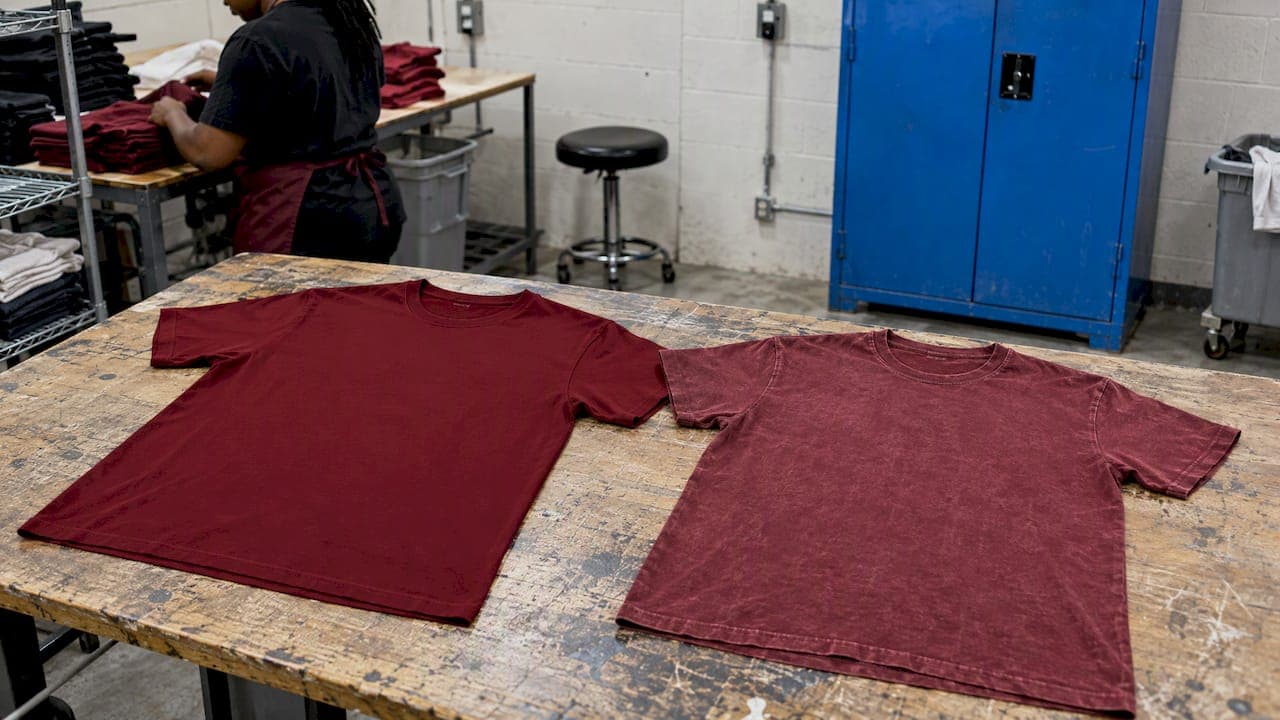
Garment dye and pigment dye are not the same thing, though they often overlap. "Garment dyed" describes when color is applied: after the piece is cut and sewn. "Pigment dyed" describes what is applied: insoluble pigment held on the surface by a binder. A pigment-dyed piece is often garment dyed too, but a classic garment-dyed piece uses dye that bonds with the fiber, so it holds color longer and more evenly.
TL;DR
- Garment dyed means the finished garment is colored after sewing. The usual dye for cotton is a reactive dye that bonds with the fiber, so color tends to be deep and even.
- Pigment dyed means color sits on the fiber surface, held by a binder. It gives a faded, vintage, slightly uneven look that keeps softening with every wash.
- Pigment fade is designed in, not a defect. Garment-dyed color with reactive dye is generally more wash-stable.
- Wash both cool, inside out, and follow the care label. Pigment pieces are the ones most likely to rub off on light furniture or bags.
- Choose garment dye for rich, steady color. Choose pigment dye if you want a worn-in look from day one.
Table of Contents
- What garment dyed means
- What pigment dyed means
- Garment dye vs pigment dye at a glance
- How they look and feel
- Fading and durability
- How to tell which one you have
- Caring for garment-dyed and pigment-dyed clothes
- What else shapes the finished garment
- Which should you choose
- Our perspective
- Shop casual wear built around comfort and style
- FAQ
- Sources
What garment dyed means
Most clothing is made from fabric that was dyed first. The mill colors the yarn or the fabric roll, then a factory cuts and sews it. Garment dyeing flips that order. The piece is assembled first and then colored. Cotton Incorporated's technical bulletin describes the finished garment going into a dyeing machine, where the dye colors the assembled piece. The same bulletin lists T-shirts, jeans, sweaters, dresses, jackets, skirts and hosiery among the items made this way.
Two things follow from that order of operations.
Soft hand. Garments are tumbled in the machine and then tumble dried, which gives the finished piece a soft feel straight off the rack. That is why garment-dyed tees and hoodies feel "broken in."
Small tonal differences. Thread, labels, and the fabric panels do not always take color identically. Cotton Incorporated notes that differences among components may create tonal effects. Color can look a touch heavier around seams and necklines. In well-made pieces this reads as character, not a flaw.
There is also a business reason brands like it. The same bulletin points out that garment dyeing supports short fashion lots, reduces excess inventory, and cuts waste from undyed apparel fabric. A brand can make plain garments and color them closer to when demand is known, which is how small drops in new colors become possible.
Which dye is used in garment dyeing
For cotton, the standard is the reactive dye. CottonWorks explains that reactive dyes form strong covalent bonds with cellulosic fibers and have good washfastness. In plain terms, the color becomes part of the fiber instead of sitting on it. The same industry booklet calls reactive dyes the standard for cotton products, thanks to their wide shade range, brightness, and strong resistance to home laundering detergents.
When shoppers say "garment dyed" they usually mean this: a finished garment colored with a dye that bonds with the fiber. That is the sense the rest of this comparison uses for "traditional" garment dyeing.
What pigment dyed means
Pigments work differently. They are not dissolved dyes. CottonWorks states that pigments are insoluble in water, show no affinity to fibers, and do not penetrate them. They apply color to the surface with a binder, a kind of glue that keeps the particles on the cloth. The same page warns that too much binder can ruin the fabric's hand, meaning it can stiffen the feel.
Pigment can be applied to fabric or to a finished garment. When it is applied to a garment, you get pigment garment dyeing, which is where the two terms collide. Cotton Incorporated's bulletin on the process says the pigment goes on after a cationic polymer pretreatment, then a binder, usually acrylic-based, which improves resistance to rubbing, also called crocking. The cationic polymer acts as a bridge between the fabric and the pigment, and it is often used to achieve a distressed look.

Is pigment dyed the same as garment dyed?
No, but they are related. Think of it as two questions:
- When is color applied? Garment dyed answers: after sewing.
- What colors the cloth? Dyed (dissolved dye bonding to fiber) versus pigmented (particles stuck to the surface).
A pigment-dyed T-shirt is frequently also dyed as a finished garment, so it can fairly be called garment dyed in the "when" sense. But a shopper who sees "garment dyed" on a tag usually means the dye-bonded kind, and a shopper who sees "pigment dyed" means the faded, vintage kind. Treating them as interchangeable is how people end up surprised by how a shirt ages.
Garment dye vs pigment dye at a glance
| Feature | Garment dyed (reactive dye) | Pigment dyed |
|---|---|---|
| How color is applied | Dye bonds with the fiber | Pigment sits on the surface with a binder |
| Typical look | Deep, even, saturated color | Muted, chalky, weathered, more tonal variation |
| Feel | Soft, broken in | Soft, can be slightly drier if binder is heavy |
| Fading | Holds color well through washing | Designed to wash down and fade over time |
| Rubbing off (crocking) | Low | Higher, especially if cured poorly or heavily colored |
| Best for | Staple colors you want to stay put | Vintage, lived-in style |
The table is a pattern, not a guarantee. A well-made pigment piece can be excellent, and a poorly finished garment-dyed piece can disappoint. Fabric weight, fiber quality, and process control all matter.
How they look and feel
Color depth
Garment dye with reactive dye gives the fuller color. The dye goes into the fiber, so shades like black, navy, forest green and burgundy look dense. Pigment dye tends to look softer. One shop-level comparison puts pigment results at roughly 10% less colorful than traditional garment dyeing, which matches what you see on racks: a sun-washed, powdery version of the same shade. Treat that number as a rough rule of thumb rather than a lab measurement.
Evenness
Both methods can look a little uneven, and for both that is part of the appeal. Garment-dyed shirts can show heavier color along seams and necklines. Pigment pieces can look mottled because the pigment is displaced on purpose to create a weathered effect. If you want a flat, uniform color like a printed-fabric polo, neither is the right pick.
Hand feel
Both are usually soft because garments are tumbled. Cotton Incorporated's guidance on finishing is that fabric hand depends on fiber, dye choice, and finishes such as enzymes and softeners. Pigment is the one where the binder can tip things the wrong way, so a heavy-handed process feels stiffer. If you are weighing how a shirt will feel, fabric weight matters as much as dye. Our guide to what GSM in clothing really tells you helps you read the number on the tag, and ring spun versus regular cotton explains why two cotton tees in the same color can feel nothing alike.
Fading and durability
This is the question behind most searches, and the answer is honest in both directions.
Pigment-dyed clothing is meant to age. Cotton Incorporated reports that pigment-dyed garments are intended to continue washing down over their life, and that washfastness depends substantially on the cationic pretreatment. Higher pigment concentration can also worsen crocking resistance, so very deep pigment shades are the likeliest to rub off. That is why a black pigment-dyed hoodie can turn charcoal and then soft gray over a year of regular wear. For many buyers, that is exactly the point.
Reactive-dyed garments behave differently. CottonWorks puts it directly: reactive dyes offer excellent washfastness, while pigments may require extra care due to potential crocking. Pigments do have an advantage: they are typically lower-cost colorants than reactive dyes and provide excellent lightfastness, meaning they resist fading from sunlight.

Color loss is not always the dye
Some of the "fade" on any cotton garment is the fabric surface changing. The CottonWorks booklet notes that abrasion in the dryer can fuzz fibers and cause apparent color loss. A shirt can look duller because the surface is roughened, even when the dye is intact. Lower dryer heat and shorter cycles help.
It also helps to think of fading as a spectrum of intent. If you buy pigment-dyed, the fade is part of the product. If you buy garment dyed with reactive dye and it fades fast, something else is going on: low-quality fabric, harsh detergent, high heat, or a pigment finish you did not know about.
How to tell which one you have
There is no single test, but a few cues add up.
- Read the tag and product page. Brands that use pigment typically say so, because it is a selling point. "Garment dyed" with no mention of pigment points to the traditional method, though it is not proof.
- Look at the inside of the garment. Reactive-dyed pieces tend to be colored throughout. Pigment pieces can show a lighter or more uneven color on the inside, since the color lives on the surface.
- Look at the seams and stitching. Slightly deeper color or lighter thread at the seams is common to both, but a washed-out, chalky cast overall suggests pigment.
- Check the finish. A chalky, faded, vintage look new off the rack usually signals pigment. A rich, saturated look with soft hand usually signals reactive.
- Rub test. On a light, damp white cloth, a gentle rub on a dark pigment piece may show a little color. A reactive-dyed piece should not transfer. Do it on a hem, not a visible panel.
A note on other terms you will see. Piece dyed means the fabric roll is colored before cutting. Yarn dyed means the thread is colored before weaving or knitting, which is how plaids and stripes are made. Both happen earlier in production than garment dyeing.
Caring for garment-dyed and pigment-dyed clothes
The CottonWorks booklet's baseline advice is to follow the care label. Beyond that, a few habits protect color on both kinds of piece.
- Wash inside out. Less surface abrasion means less visible wear on the face of the fabric.
- Use cool or cold water and a gentle cycle. This is the single most useful change for pigment pieces.
- Wash dark colors together, especially in the first few washes, since new garment-dyed pieces can release some excess dye.
- Skip bleach and harsh detergents. Choose a mild liquid detergent.
- Dry low or hang dry. Dryer abrasion can fuzz fibers and make color look duller.
- Be careful with light surfaces. A brand-new dark pigment piece can crock onto a white couch, car seat, or canvas bag.
For more on laundering heavier pieces, see how to wash hoodies the right way without shrinking them. If you are comparing fibers as well as dyes, our poly cotton versus cotton home tests and the tri blend versus cotton shrinkage breakdown are useful companions, since a polyester blend does not take these dyes the same way cotton does.
What else shapes the finished garment
Dye choice is one variable among several. Fiber type, dye selection, and finishes such as enzymes or softeners all influence colorfastness and hand. Pigment garment dyeing in particular requires precise process control, including binder application, to get reproducible color between dye lots. That is why two production runs of the same "vintage black" tee can differ slightly. It is also why a brand that cares about consistency will test lots before shipping.
Garment dyeing also asks more of everything attached to the piece. Thread, trims, and labels all go through the dye bath, so they must survive it. This matters for anything decorative: embroidered or woven additions have to be chosen with the process in mind. If you are curious about how decoration choices differ, this breakdown of twill versus fully embroidered patches shows how construction affects the look of a finished piece. Printing is a related decision: how a design sits on a garment-dyed or pigment-dyed base depends on the method, so our comparison of DTG versus screen printing is worth a read before you buy or design graphic pieces.
Which should you choose
Pick garment dyed if you:
- want deep, steady color that stays put through frequent washing;
- buy staples like black, navy, olive, or white-adjacent neutrals you expect to wear for years;
- dislike the idea of color transferring onto other things.
Pick pigment dyed if you:
- want a vintage, sun-faded look from the first wear;
- like clothes that keep changing and softening;
- are happy to wash cool and gently to control how fast the fade goes.
If you cannot decide, consider the color. Mid-tone and light colors hide pigment fade well. Very dark pigment pieces show the change most, and some people love that while others feel the shirt gave up too soon. Fabric choice also works alongside dye. Our T-shirt fabric types guide and ultimate guide to T-shirts cover how fiber, weave, and weight combine with color to decide how a shirt wears.
Our perspective
We think of clothing the way we think of music: it should feel right the moment you put it on, and it should keep feeling right on a Tuesday, a Saturday night, and a long drive between the two.
That is why we pay attention to dye. Color is not just a look. It is how a piece ages on you. A faded, lived-in tee and a rich, saturated one are both legitimate style choices, and the best choice is the one that matches how you actually wear and wash your clothes.
Our approach to casual wear is comfort first, then versatility, then the details that make a piece feel like yours. A good piece should work with jeans, joggers, or a jacket, in the studio or out with friends. When you understand the difference between dye that bonds with the fiber and pigment that sits on it, you stop guessing and start choosing clothes that fit your life.
We keep a blog full of practical guides like this one because informed buyers become loyal fans, and a fan who loves what they are wearing is the whole point of this brand.
Kenny Wade
Shop casual wear built around comfort and style
If you are ready to put this into practice, Kenny Wade's World pairs casual wear and branded merchandise with the music and community behind it. Our pieces are designed to be comfortable, versatile, and easy to wear across different occasions.
Browse the full range at Kenny Wade Clothing, or read more about the artist and the brand on the Kenny Wade about page. Product pages list the details for each piece.
FAQ
Is pigment dyed the same as garment dyed?
No. Garment dyed refers to coloring a piece after it has been cut and sewn. Pigment dyed refers to color held on the surface by a binder. A garment can be both, but traditional garment dyeing uses dye that bonds with the fiber and holds color longer.
Is garment dye better than pigment dye?
It depends on what you want. Garment dye with reactive dye gives deeper, more wash-stable color. Pigment dye gives a faded, vintage look that keeps softening. If you want color to stay put, choose garment dyed. If you want a worn-in look, choose pigment dyed.
Does pigment-dyed clothing fade in the wash?
Yes, and by design. Cotton Incorporated notes that pigment-dyed garments are meant to keep washing down over their life. Washing cool, inside out, and drying low slows the change but will not stop it.
How is pigment dye different from reactive dye?
Reactive dye forms a chemical bond with cotton fibers and has good washfastness. Pigment does not penetrate the fiber and is attached to the surface with a binder. Pigments are typically lower cost and resist sunlight well, but they can rub off more.
Sources
- Garment Dyeing of Cotton Apparel, Cotton Incorporated technical bulletin
- Garment Dyeing With Pigments, Cotton Incorporated technical bulletin
- Dyeing Basics, CottonWorks
- Textile Dyeing booklet, CottonWorks
- Twill vs. Fully Embroidered: Which Should You Choose?